A Thousand-Year-Old Fight
From Napoleon to Trump, powerful men have tried to bring the papacy to heel. It rarely works.
How it starts
Imagine this: the most powerful man in the world refuses to look at the pope in Rome as a moral counterweight, but instead as an impediment -- out of touch, meddlesome. Then the pontiff fires back, warning against the vice of pride, the seduction of power, and the belief that military strength alone cannot settle questions of right and wrong.
It quickly escalates beyond a war of words, with accusations that the pontiff is clinging to outdated values and “a policy, which, while good in other centuries, is no longer appropriate to the century in which we live.”
But the pope doesn’t back down. He doesn’t have his adversary’s armies, resources, and his knack for humiliating adversaries, but the leader of the world’s Catholics is convinced he has the moral high ground.
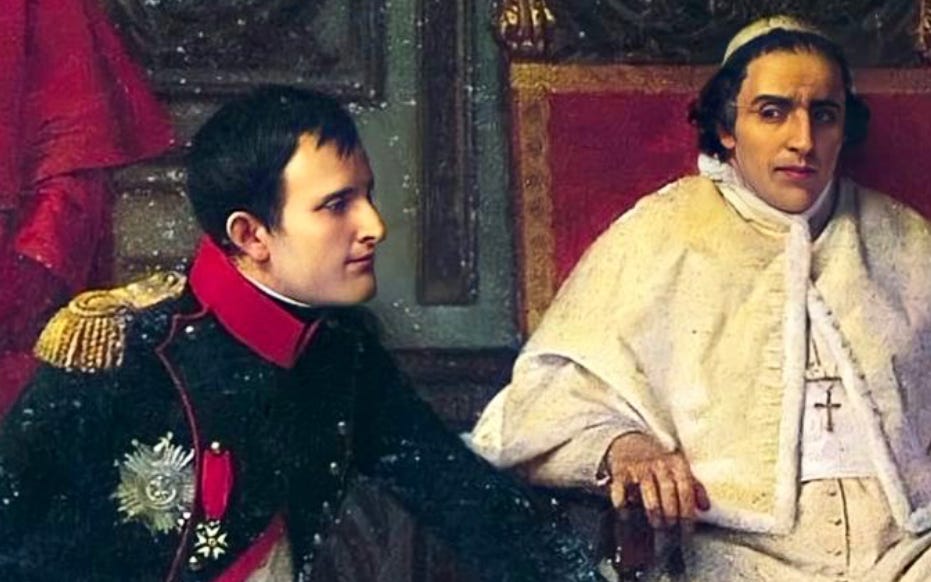
That political leader was Napoleon Bonaparte; the pope, Pius VII. Their standoff was in 1809. And if the story sounds familiar, that’s the point.
The familiar script
The current clash between President Donald Trump and Pope Leo XIV has so far been mostly rhetorical -- aside from an apparent Pentagon threat that reopened a 700-year-old wound about when the papacy was forced to abandon Rome for 68 years (more on that below).
“The United States has the military power to do whatever it wants in the world,” a U.S. Department of Defense official reportedly told the Papal nuncio behind closed doors. “So the Catholic Church had better take its side.”
For his part, Trump opted for advice and insults, calling on the pontiff to “get his act together as pope, use his common sense, stop catering to the radical left, and focus on being a great pope, not a politician.”
Trump concluded: “I’m not a big fan of Pope Leo.”
The situation is tense enough that the American-born Leo reportedly shelved plans to visit his birth country this year, insisting he is “not afraid of the Trump administration or speaking out loudly of the message of the gospel.”
Multiple leaders stepped up in the pontiff’s defense, including, significantly, Italian Prime Minister Giorgia Meloni, a long-standing Trump ally. Trump once called her “a beautiful young woman” -- high praise from the president -- and “an incredible and highly-respected leader.” The press (me included) has been calling her a “Trump whisperer.”
Meloni kept her head down during unpopular Trump moves including tariffs, demands on defense spending, and support for Ukraine.
But it took Trump’s rhetoric toward Leo to strain relations between the West’s two most prominent nationalists. Meloni, who grew up Catholic, denounced Trump’s criticisms of the pontiff as “unacceptable” and said that it was “right and normal for [the pope] to call for peace and condemn every form of war.”
Trump’s response? “I was shocked,” he said. “She’s the one who’s unacceptable.” There was no word on whether he still thought she was beautiful.
Avignon and the Iron Curtain
In the early 14th century, King Philip IV of France clashed with the papacy over political matters and had one pope arrested. Then, in 1309, he forced the papacy to abandon Rome for Avignon, in France -- the episode that resurfaced in the threat to the Papal nuncio earlier this year. The papacy stayed there until the mystic Catherine of Siena shamed Pope Gregory XI into returning to Rome.
King Henry VIII took a different approach. When Pope Clement VII refused to annul his marriage to a different Catherine, Catherine of Aragon, Henry created the Church of England and declared himself its head. Now, nearly 500 years later, that wound is only starting to heal.
During World War II, Nazi troops rounded up Roman Jews within sight of the Vatican walls, but Pope Pius XII said nothing publicly -- a silence that remains fiercely debated among historians (the pope did protest privately, and Vatican officials sheltered some Jews and offered protections to those who’d been baptized as Catholics).
And during the Cold War, Polish-born Pope John Paul II stared down the Soviet Union, armed with the insistence that human dignity was not negotiable. Reagan, Gorbachev, Thatcher, and the CIA all played big roles, but the pontiff gave those behind the Iron Curtain their moral vocabulary.
“Conflicts between popes and rulers are not an aberration,” wrote Joëlle Rollo-Koster, a historian and lead editor of The Cambridge History of the Papacy. “They’re a durable feature of Western history. Whenever political leaders cloak power in sacred language or religious leaders publicly denounce political violence, they reenact debates that stretch back more than a millennium.”
Napoleon’s lesson
Back to 1809, when Napoleon’s troops forced their way into Rome’s Quirinal Palace and seized Pius VII, taking him back to Fontainebleau, just south of Paris. Four years later, the pontiff was forced to sign a concordat granting Napoleon control over much of the operations of the church Pius later invalidated the agreement because it was coerced, and their standoff delegitimized Napoleon in the eyes of many of his supporters.
In 1814, Pius returned to a hero’s welcome in Rome, a year before Napoleon’s final military defeat at Waterloo. The French leader died in exile in 1821, while Pius was still pope.
In his final years in exile, Napoleon reportedly acknowledged the durability of the institution he’d attempted to bend to his will. “Alexander the Great declared himself a son of Jupiter,” the Frenchman said. “And in my time, I have met a priest more powerful than I.”
📌 And another thing:
I’ve long been fascinated by the Vatican’s role in world affairs -- not spiritual affairs, but raw geopolitics.
It’s the world’s smallest country: fewer than 700 citizens, no standing army. Its official language is Latin. Yet, it can move nations. That was the subject of my first-ever Italian Dispatch essay (temporarily unlocked). It was written nearly a year ago and sent to a mailing list of exactly 27 readers.
My thinking on the Vatican was shaped in part over more than two decades by John Allen: author, editor, founder of Catholic news site Crux, and the kind of contact any journalist hopes for: brilliant, funny, generous, and quick to respond. He was quoted prominently in that first Dispatch essay as well as dozens of my other articles dating back more than 20 years.
Once, at Fiumicino Airport, we realized we were on the same flight to the U.S. and we convinced Alitalia staff to seat us together. We spent most of the flight talking about our lives as American transplants living in Rome. The Vatican only ever came up in passing.
Last summer, John and I tried more than once to watch a Detroit Tigers-Kansas City Royals baseball game together at his place outside the Vatican walls. He was a Royals man; I’ve cheered for Detroit dating back to my university days. But it never happened -- we kept postponing because of his cancer treatments.
John died on January 22 at the age of 61.
The next baseball series between the Tigers and the Royals gets underway in Kansas City on May 8, the one-year anniversary of Pope Leo’s papacy.
Nota bene: The Vatican has a long memory -- and so does this newsletter’s archive, with 48 essays and counting. A paid subscription unlocks the full collection and helps make The Italian Dispatch sustainable. More info here.


P7 serving serious side eye in that header image. Great choice.
What a great photo (image) to start out with. So interesting. Doesn't the example of Pope Pius XII kind of prove the opposite point, that the Fascists were able to push him around and force him to keep quiet?
I'm sorry to hear about the loss of John Allen. I didn't know. I remember seeing him on CNN.