America in Italy; Italy in America
What two centuries of 'cultural borrowing' got right, and what it’s getting wrong
A nearly forgotten chapter in the life of Giuseppe Garibaldi was written during the Italian founding father’s three-year exile in the United States in the 1850s.
Garibaldi occupies a unique place in Italy’s history: a swashbuckling general and a folk hero whose thousand red-shirted volunteers helped stitch nearly a dozen kingdoms and duchies into a single country.
Starting in the 1830s, he became a student of insurgency while fighting in revolutions in Brazil and Uruguay. He returned to Italy with an understanding of the guerrilla tactics and symbolic politics that would define his life.
In 1848, Pope Pius IX fled Rome for Gaeta amid extreme political unrest. Garibaldi and other revolutionaries stepped into the void, establishing the secular and progressive Roman Republic. But it was short lived.
After just five months, the fledgling state was crushed by French troops sent by Napoleon III, the pontiff was restored to the Vatican, and Garibaldi became a wanted man. He secretly left Europe and eventually settled on a farm on Staten Island in New York.
There, he admired many aspects of the American system -- the absence of monarchy, for example, and the revolutionary origins of the country -- though he was staunchly opposed to slavery. He lived quietly as a farmer and candle maker, but in his free time he plotted his return to Italy and the unification of the Italian peninsula.
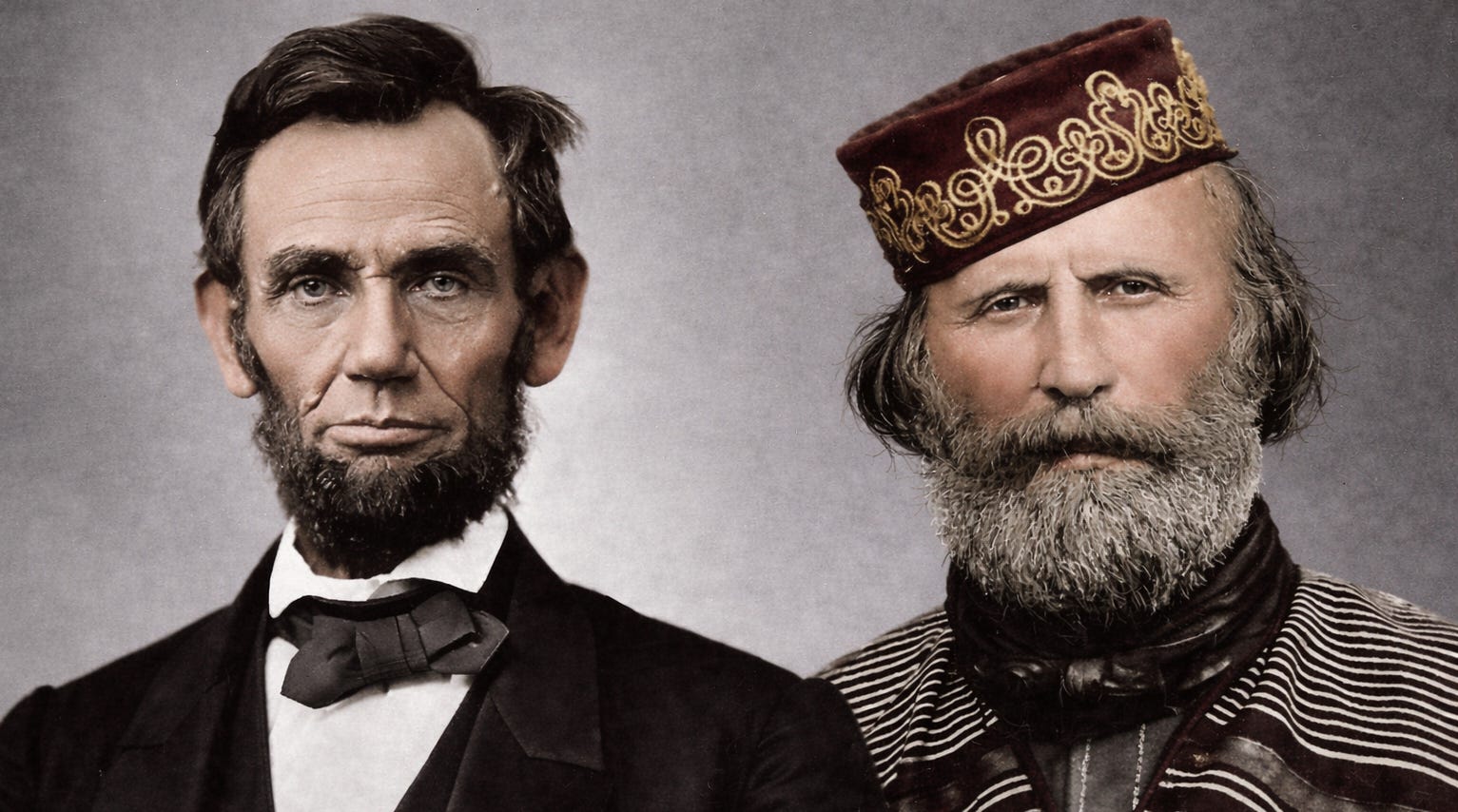
In 1860 and 1861, Garibaldi and his Mille volunteer forces succeeded where the Roman Republic failed, unifying most of present-day Italy. The U.S. was embroiled in its own Civil War, but it still became the first non-European state to diplomatically recognize the newly created Kingdom of Italy.
Then, beginning in late 1861, President Abraham Lincoln seriously courted Garibaldi to return to the U.S. to take command of the Union Army.
By then, the Italian was an experienced guerrilla leader with a global reputation. His appointment was seen as a way to draw international attention and moral legitimacy to the Union’s cause.
“Garibaldi’s name alone would be worth more to us than an army corps,” Lincoln’s Secretary of State William Seward declared in 1862.
Garibaldi came very close to accepting. But he ultimately declined when Lincoln said he could not make the immediate abolition of slavery the explicit aim of the war.
None of this stands alone, of course, it was part of a long conversation. The gradual, selective cross-pollination of political and cultural ideas between Italy and the United States is built into the modern histories of both countries.
When borrowing worked …
Beginning in the late nineteenth century, the trans-Atlantic exchange elevated both sides.
Italians emigrated to the U.S. in massive numbers, reshaping American cities, cuisine, labor movements, and popular culture. At the same time, American political ideas were helping Italy modernize, and U.S. economic support helped the country prosper.
Carmaker Fiat became Italy’s first industrial powerhouse after executives studied mass production methods at the Ford Motor Company in Detroit in the early 1900s.
Italian filmmakers imported American technology and commercial models, then helped transform cinema into a global art form. The world’s first true film festival was held in Venice in 1932, elevating the prestige of cinema at a time when Hollywood still saw it as entertainment.
Directors including Roberto Rossellini, Vittorio De Sica, and Federico Fellini introduced realism through on-location shooting, while Cinecittà turned Rome into “Hollywood on the Tiber,” and low-budget Italian Spaghetti Western films created cinematic ripples that are still being felt today.
American-style democracy shaped Italy’s Postwar constitution, while the U.S.’s Marshall Plan rebuilt war-torn Italian infrastructure and lifted millions out of poverty. During il miracolo economico, Italy emerged as one of the world’s fastest-growing economies in the 1950s, 1960s, and early 1970s.
This level of borrowing worked well because it was selective.
Each side absorbed what it needed and filtered out the rest.
… And when the filter failed
In recent decades, the exchange has continued but the quality of it has changed. Today, each country seems to be absorbing some of the other’s least desirable traits, often in ways that erode cultural strengths.
Italy, instead of drawing on American dynamism -- its efficiency, innovation, civic confidence, and its belief in social mobility -- has absorbed a more superficial version of U.S. culture. Consumerism has intensified. Employment has become more precarious. Highly processed food is more common, obesity is rising, and stress (once seen as a uniquely American problem) has become part of everyday life. Even American tipping culture has begun creeping into Italian life, normalizing underpaid labor and weakening cultural norms.
Meanwhile, the U.S. appears to be importing some of Italy’s chronic dysfunctions -- though it is doing so without the social fabric that keeps them manageable.
American politics has grown polarized, loud, fragmented, theatrical, and bureaucratic. Trust in institutions has declined and cynicism is on the rise. American birthrates are falling.
The U.S. has even imported one of Europe’s oldest pathologies: a self-perpetuating elite. There’s still no formal, titled aristocracy. But there is a class of ultra-wealthy residents entirely insulated from consequences.
What is just as striking is what has not crossed the Atlantic.
Italy could have imported America’s sense of optimism, its tolerance for failure, its meritocracy, and its belief that institutions should be improved rather than endured.
And why couldn’t the U.S. have claimed Italy’s reverence for beauty or the country’s zest for life? Or its devotion to public spaces or its resistance to turning interactions into transactions? Why not its commitment to shared meals or the notion that adequate leisure time is necessary?
For most of the modern era, the trans-Atlantic exchange was deliberate and effective. Each side took what it needed, and everything else was filtered out. The borrowing never stopped. The exchange continues. What’s missing now is the filter.
📌And another thing
I’ve always been fascinated by “What-if” historical speculations. What if the Roman Empire survived until modern times? What if the Protestant Reformation failed? What if Italy joined the Allies at the start of World War II?
Another good one: What if Giuseppe Garibaldi accepted command of the Union Army in 1862, after uniting most of Italy?
On the American side, the consequences could have been immediate. Emancipation of the slaves might have come sooner, and liberal European states such as the U.K., France, and Italy would have found it harder to sympathize (even tacitly) with the Confederacy.
Then again, the appointment could have backfired. Would Garibaldi have clashed with West Point-trained officers? Would Northern troops have rallied around a foreign leader? Could he have been an effective on-the-ground commander in a country he hardly knew?
But the most interesting questions concern Italy and Italians.
Garibaldi might have ended up as less of a purely Italian icon and more of a global figure -- so, fewer Via Garibaldi in Italian cities and more Garibaldi Avenues in the United States.

Italian Americans who in the late 1800s pushed for the establishment of Columbus Day to celebrate Italian Heritage would have probably lobbied for Garibaldi Day instead, though the Italian’s birthdate -- July 4 -- was already taken.
Back at home, Garibaldi might have faced criticism for abandoning his country at a critical moment. But he would have clearly stood on the right side of history in fighting against slavery, aristocratic privilege, and colonialism across three continents.
It’s also possible that his close association with Abraham Lincoln -- an elected leader waging war to fight against slavery -- rather than with the Savoy monarchy would have weakened the case for the royal authority of King Victor Emmanuel II, nudging Italy toward becoming a representative Republic decades before 1948.
In the U.S., Italian immigrants might have been culturally linked to loyalty to the Union and emancipation more than to Italian stereotypes of anarchist violence and organized crime.
Most importantly, the collaboration would have reshaped the relationship between the two countries themselves.
Italians might have begun seeing the U.S. as a moral cousin instead of a mythical land of opportunity. And Americans might have learned to see Italy as more than ancient ruins, operatic music, the Catholic Church, and the Mafia -- but also as the homeland of the man who helped lead the fight to end slavery.
P.S.:
This essay is necessarily a selective reading of a long and complicated trans-Atlantic exchange. If you noticed other moments when Italy borrowed well (or badly) from the U.S., or where the U.S. picked up Italian characteristics I didn’t mention, or if you outright disagree with any of this, I’d genuinely like to hear about it in the comments.


I’m curious what readers on either side of the Atlantic have noticed firsthand about the cultural exchange between Italy and the U.S.
Where do you think the U.S. got Italy right or wrong? And where has Italy subtly changed American life? I’m happy to be corrected or challenged here.
Fantastic piece Eric! As the spouse of a 2nd generation Italian American from Staten Island I can say that Garibaldi still looms large for many Italian Americans. Very interesting to learn more about his history.