✍️ Beauty and the Seven Beasts
On treating a country as scenery and its people as stage props
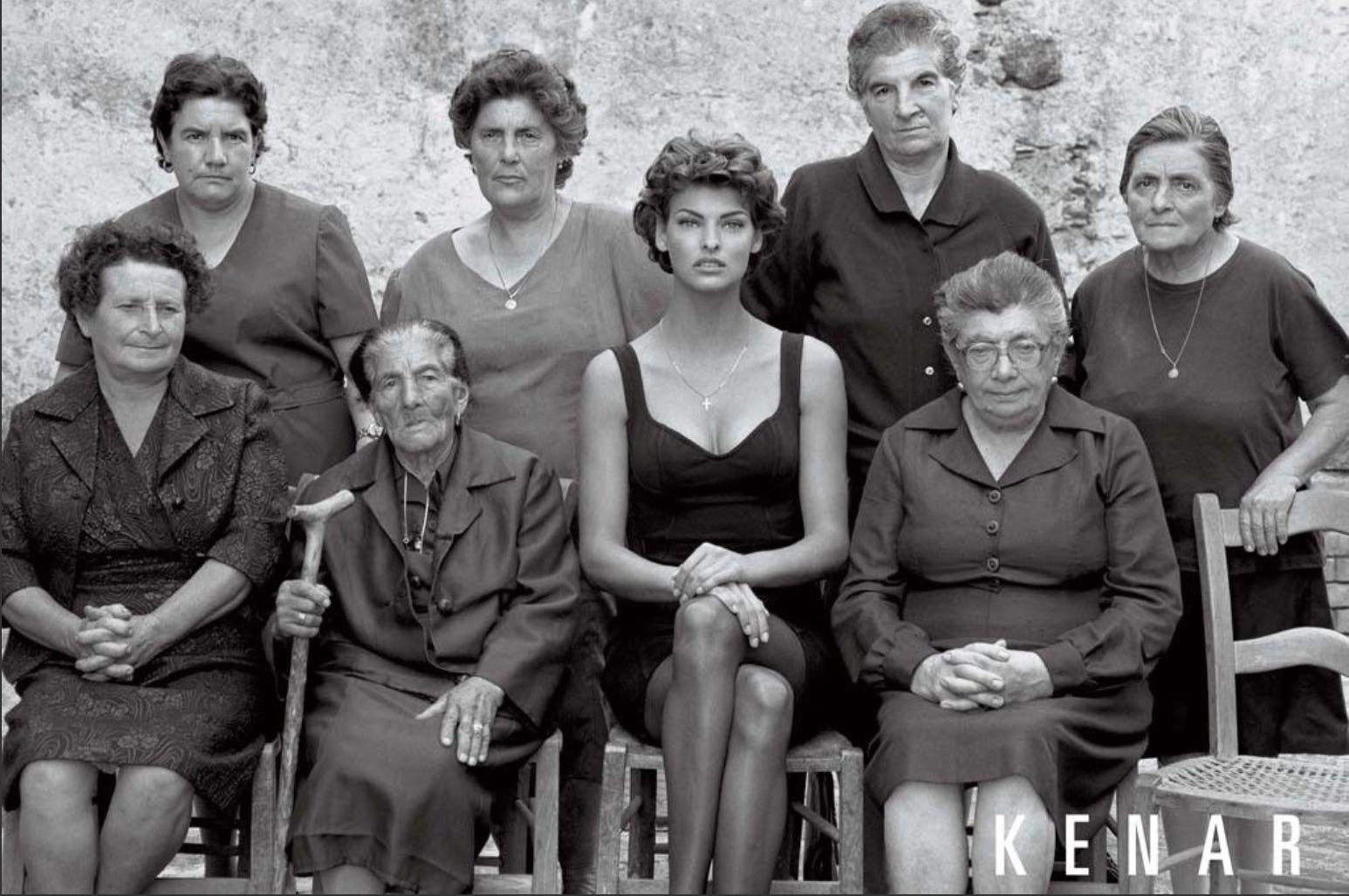
Thirty-five years ago this summer, New York fashion brand Kenar launched an ad campaign the company said was designed to call attention to the then-burgeoning AIDS epidemic. At the center of the campaign was a photograph: runway model Linda Evangelista, seven elderly Sicilian widows, and an empty chair.
The striking black-and-white image was sold as a limited-edition print, it towered over Times Square, and it appeared in newspapers and magazines. It also backfired on Kenar after the New York Post cruelly dubbed it “Beauty and the Seven Beasts,” igniting an uproar from Italian Americans.
Back in Savoca, Sicily, the widows who’d been paid 10,000 lire each -- around €12 today in terms of buying power -- said they’d been misled and humiliated. One, Maria Cisto, the woman with an intense stare, standing farthest to the left in the photo, sued the company. She was eventually awarded 20 million lire, around €17,000 in buying power today. But by the time the court reached its decision in 2000, Cisto had been dead for three years.
Kenar didn’t survive Cisto by much: the company filed for bankruptcy in 1998. But the fashion house had hardly been the first to use Italy as a stage set or Italians as props, all meant to invoke authenticity.
Wealthy Europeans have been consuming Italy as scenery since the Grand Tour, when young aristocrats spent months or years in Italy and returned home with souvenirs of antiquity and art to show how meaningfully they’d spent their formative years.
The loudest recent example may have been the Jeff Bezos-Lauren Sanchez spectacle-slash-wedding in Venice last year. The Amazon founder rented a wide swath of the city and turned it into a backdrop with a security perimeter. Locals hung protest banners and someone floated an effigy of Bezos, clutching an Amazon delivery box, down the Grand Canal.
For non-multibillionaires, the transaction can be done on the cheap. All it takes is a phone, a social media account, a dose of vanity, and an eye for turning real places into background scenery.
There’s even an edible version of this transaction: Italian Sounding products -- items dressed up with tricolor packaging and vaguely Italian names, made far from Italy’s borders. The country’s main agriculture lobby says these imitation products outsell genuine Italian food exports nearly two-to-one. And the single most counterfeited product of all is the one I ate by the fistful as a kid: parmesan.
But I think the most interesting versions of the trend are more subtle, and often beloved.
In his Searching for Italy series, host Stanley Tucci repeatedly searches for a version of Italy that’s been elaborately staged but is presented as happenstance. Still, the series is full of fascinating moments where real Italy forces itself onto the screen and a local character brings up the politics or grievances of an actual life going on beyond the scene.
Or take the popular expat-memoir genre -- books like Under the Tuscan Sun or Eat, Pray, Love -- where Italy is cast as a place where foreigners come to “find themselves” while Italians too often play the role of friendly, wise, sensual furniture.
Even this newsletter is somewhere on the spectrum, though I hope it’s nearer the thoughtful and polite end of it. I try to encourage real engagement with the country, a kind of “thoughtful tourism.” But to do that, I still present my own version of the country every Tuesday, with my own cast of recurring characters most readers won’t ever meet. The essays are affectionate, but they still use the country as content.
Italy has been photographed, painted, adored, misunderstood, and mythologized for centuries. That won’t stop. But the people in the frame are people.
A waiter isn’t a symbol of Italian hospitality any more than a nonna is a window to the past or a fisherman is a mere accessory to a lake view. And the women in the Kenar photograph were more than symbols of age or tradition deployed like decorations around a supermodel.
The Kenar photo was taken in Savoca, a hill town known to the world as someplace else.
Savoca stood in for the village of Corleone in The Godfather because the real Corleone had become too modern to look the part. The bar where Michael asked for Apollonia’s hand in marriage was renamed for the film and it has used the “fictional” version ever since. The bar is now a draw for tourists, its previous name forgotten.
In the same way, we only know one of the seven widows by name. Maria Cisto sued, won, and died before the verdict was reached. Her name survived. But the other six ended up with nothing but the ugly name from the Post’s headline -- six more empty chairs in a photo that only had one.
Nota Bene: Anyone can sell you the backdrop. This newsletter is trying to give you the actual place. Paid subscribers get access to all of it: the nearly 60 essays in the archive, plus a monthly emailed digest of recent posts and highlights from the reader comments. Click here to learn more.


Great angle on such a difficult subject— I didn’t remember that photo until i saw it here. You’re right— if you write about Italy, it’s very hard to avoid turning people into symbols or bit players in an opera buffa. The fact that you’re thinking about it and looking at the ramifications of it is why we appreciate the Italian Dispatch!
I so look forward to your dispatch every Tuesday. My day (or week) would not be the same without your wit and writing! I always learn from your essays, each one feeding my internal need to keep an open mind and fill the gap with new knowledge. Your reference to Kraft parmesan is always appreciated. Ever since your "lesson" at Christmas, Betty and I "upped" our personal demand to real and not shaken from a can. You spoiled us. And we are grateful! And, we are so looking forward to seeing you soon!