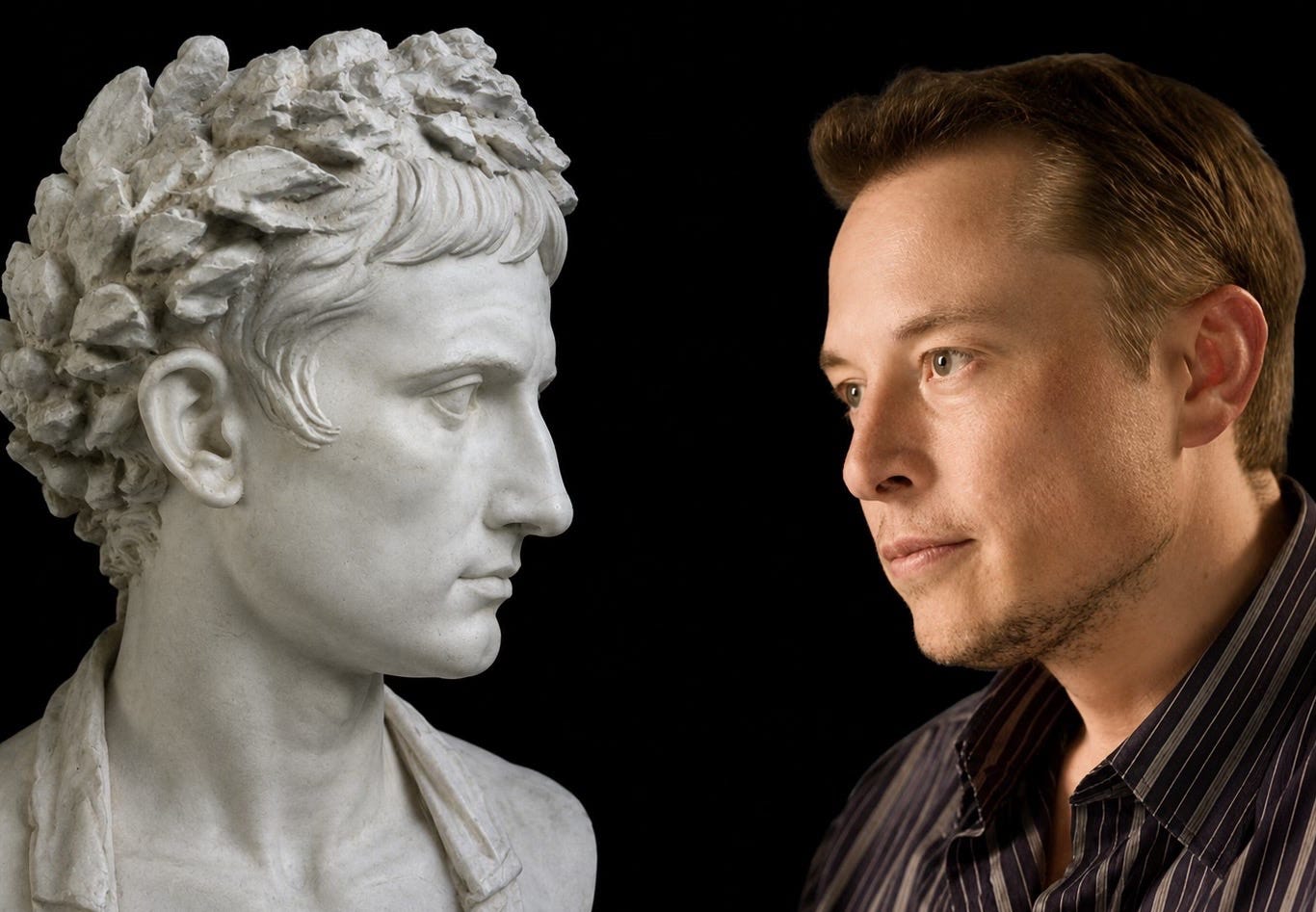
✍️ Elon Musk’s Paper Empire
What Roman history tells us about the difference between fortune and power
A million seconds ago, tech magnate Elon Musk was not yet a trillionaire. A billion seconds ago, Italy was still using the lira currency and media tycoon Silvio Berlusconi was new on the political scene. And a trillion seconds ago was pre-history: people still lived in caves, animals had yet to be domesticated, and the ground beneath modern-day Venice was more than 200 kilometers inland.
This month, Musk became the first person with a net worth north of a trillion U.S. dollars -- that’s a number with twelve zeros behind it (as of publication, he’s not quite there in euros).
I need help in understanding numbers that large. Thinking in seconds is one way. Here are a few others: His fortune is around the size of the annual economic output of Switzerland or Saudi Arabia. Collected in 100-dollar bills, his wealth would weigh more than the Eiffel Towerin Paris. Musk’s net worth is the equivalent of two-thirds of all the physical euro banknotes in circulation.
These kinds of comparisons may help us understand how large Musk’s fortune is. But they do not tell us what comes with that kind of wealth.
For that, we need Caesar Augustus.
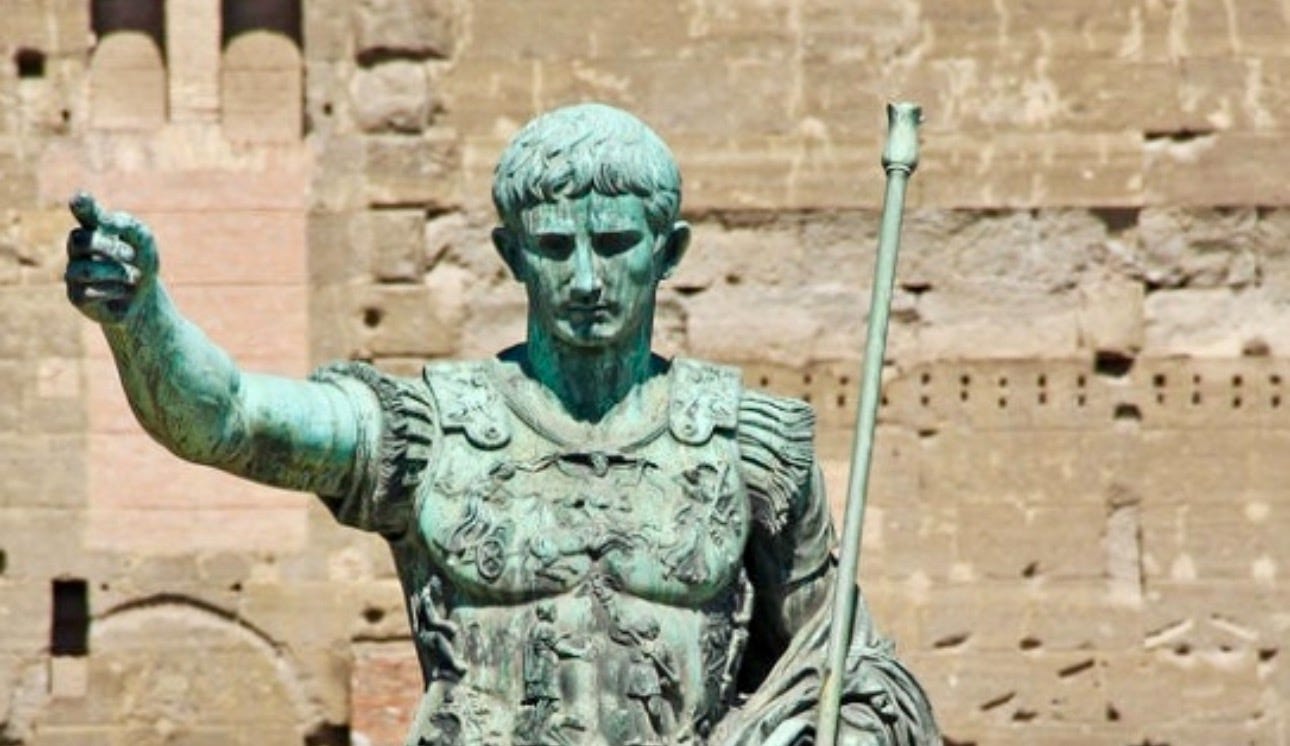
Like Musk, Augustus was the richest man of his time. But in Augustus’s Rome, that was near the bottom of the list of reasons he was important.
Augustus, who called himself Princeps, or First Man, was also the head of state, commander of every military legion -- legions whose soldiers swore their oaths to him, not to Rome -- and the culture’s highest religious authority. He transformed Rome from a city of brick to a city of marble.
Imagine Musk with his fortune and the presidency of the United States and command of the Pentagon and the papacy. That’s a modest sketch of the reach of Augustus’s power.

Of course, Musk is more than his trillion-dollar net worth. He builds the rockets the U.S uses to get to space. His satellites have redefined the rules of war. He owns a global version of the public square. And for a season, he even had an office inside the White House, where he dramatically slashed government aid programs.
The power of both men spilled beyond their bank accounts and into the machinery a state depends on. Both were strategic. Both were ruthless. If there’s a modern-day Augustus, it’s Musk.
Yet he doesn’t come close. Almost everything Musk has is conditional. He has paper riches he cannot easily sell. He owns shares in companies whose valuations can fall, contracts that can be canceled, platforms users can abandon, and political favor that can be withdrawn.
Musk holds his power one economic quarter at a time. Augustus held his position by law, for life, and he handed it to an heir.
That’s the difference between the richest man in the world and the First Man of the world.
Nota Bene: Regular subscribers borrow this place. Paid subscribers own it -- all of the nearly 60 essays in the archive, plus an emailed monthly digest of recent posts and the best reader comments. Click here to learn more.


I don't think Elon's going to subscribe to your newsletter.
It would weigh more than the Eiffel Tower??? OMG. There's something wrong with the world when some people can have that much money and people are still starving. Both Cesar Augustus and Musk are obscene