✍️ Italy, According to Online Reviewers
'A big pile of rocks,’ ‘gratuitous nudity,’ and the risks of the 'influencer echo chamber'
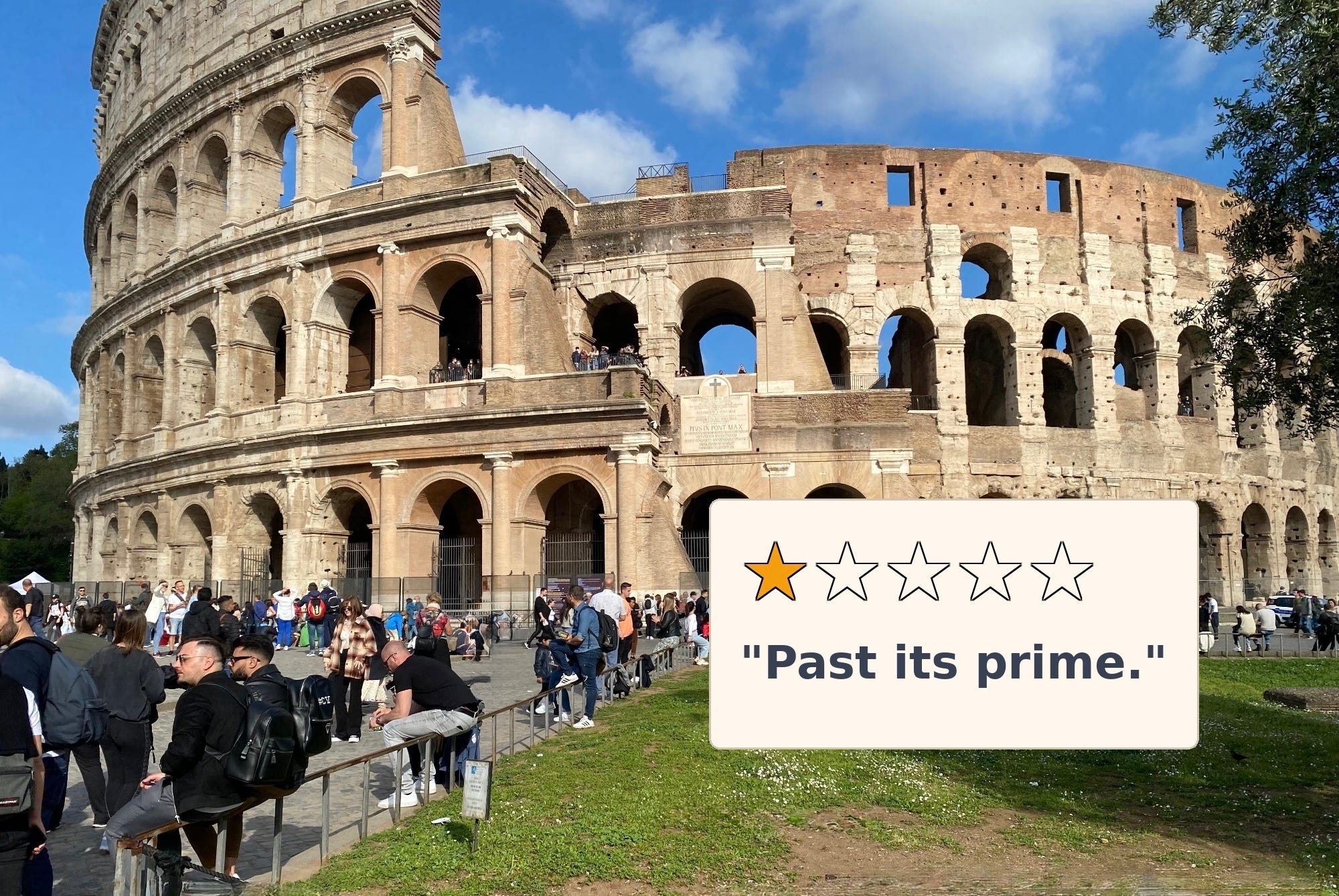
The Colosseum has survived earthquakes and fires, the collapse of the Roman Empire, being looted for parts, wars and invasions, and the urban stress of traffic and pollution.
Now it is facing the angry wrath of the disappointed modern-day tourist.
“Past its prime,” wrote one tourist from California. “Takes up an absurd amount of space,” quipped another visitor, this one from Colorado. A tourist from the U.K. said it was “nothing more than a dirty, crumbling eyesore,” while another Brit called it “the worst of all tourist attractions.” From another Coloradan: it “seemed like it hadn’t been used in years.” And in what might be the most succinct of all the Colosseum’s negative reviews, a visitor from Australia labeled the site simply “a big pile of rocks.”
Of course, the Colosseum isn’t alone.
An Indian tourist described the nearby Roman Forum as “a big hole near the Colosseum where all the rocks are kept.”
Further afield, a Scottish traveler blamed the Leaning Tower of Pisa for being “much smaller than I imagined.”
The Uffizi in Florence? Filled with “low-quality art … [and] gratuitous nudity,” according to a Californian, while another from the same state called it “a complete waste of time and money.”
A tourist from Alabama said Venice’s Peggy Guggenheim Collection was full of “third-rate works … [that] would never make it to the wall of the average American living room.”
But few reviews can match the insight of an English visitor who complained that the Grand Canal in Venice “was under water when I saw it.”
The uninformed commentary cuts both ways.
How deeply do you think this Greek visitor studied Naples’ 200-year pizza culture before declaring dinner at Pizzeria La Notizia the “Best. Pizza. Ever.”? Or how many of the capital’s 1,500 gelaterie did this German visitor sample before concluding that Sweet Life Gelateria had “The best gelato in Rome”? Not to mention the “hidden gem” of a hotel just steps from Florence’s Ponte Vecchio or the “secret spot” right next to Milan’s Duomo.
Reviews like these are always good for a smug laugh.
But they also point to something worth taking seriously: this same pool of misguided commentators is where most would-be travelers go to when planning their trips.
I’m fairly active in Reddit groups focusing on Italy and on Rome, and I can’t begin to count the number of times I’ve seen posts from soon-to-be visitors showing “research” about authentic restaurants or activities drawn entirely from online reviews. It creates what fellow Substacker Jeffrey Merrihue calls “the influencer echo chamber.”
In other words: Travelers who rely too much on the wisdom of the crowd end up traveling with the crowd.
So what’s the alternative? I think the best thing is to ask an in-the-know local. Short of that, I’ll suggest three other approaches:
Filter for reviews in the local language. I do this often when traveling outside Italy. AI tools now make it easy even if you don’t speak the language. If the scores are decent, the specific wording doesn’t matter. When locals are eating there -- and bothering to write about it -- that says more than any five-star review from an out-of-town visitor.
Look for what I think of as “good bad reviews.” If a tourist knocks a place for the absence of an English-language menu or for being filled with “loud-talking Italians,” that’s usually a sign it might be worth a visit.
Or just rely on your instincts. Walk a block or two off the tourist drag. Avoid places with waiters outside trying to cajole people in or food photos on the menu. A pasta-making nonna in the window is a warning. But a chalkboard listing piatti del giorno or the right kinds of stickers on the door are more helpful than your phone.
Another fellow Substacker, Danielle Oteri, recently reposted a sweet, nostalgia-filled essay recalling what travel was like before influencers and mobile phones. I also feel nostalgic about simpler times.
As for what to do when you actually encounter one of the under-informed commentators in the wild, I’ll defer to veteran archeologist and tour guide Livia Galante. She recently told me about a visitor she was showing around the Palatine Hill.
“He said the whole thing was just ‘dust, broken walls, and old stuff,’ and that Italians were ‘too lazy to rebuild it’.”
Her response: “I told him he should go to Disney World on his next trip.”
✍️ These shorter Dispatch-style pieces appear every other Tuesday, in the weeks between the long-form features. Come back next week for another full essay.
Nota bene: If this essay made you think twice about trusting the crowd, consider supporting the newsletter that brought it to you. Paid subscriptions help keep The Italian Dispatch going, and they unlock the full archive and include a few other perks. There’s also a special offer through March 31. More information here.


OH PLEASE.... Make all the tourists find someplace else to trample and inundate with their opinions and boorish behaviors!
I have wished for almost 30 years that they will stay away from my beloved Tuscany!
The hyperbole of the positive reviews doesn't bother me that much. But the negative ones are incredible! Are you sure they weren't written ironically? The one who didn't know the grand canal was (wait for it) a canal or the one who didn't know the Colosseum was old? Is anyone really THAT stupid?