It’s Not What You Know.
How raccomandazione decides who gets a chance in Italy -- and why it endures

‘Who helped you?’
During lunch, years ago, I told my landlord, Massimo, I needed a new part-time assistant. It was a work-from-home job: producing daily news summaries, setting up interviews, answering correspondence in Italian and English, and arranging travel.
“I’ve got just the person for you,” Massimo said.
Federica was the younger sister of Massimo’s wife’s closest friend. And she was not a good fit.
Before I could ask a single question, she told me she couldn’t start working right away because her family would be at their beach house for two weeks. She thought starting work at 8 a.m. was too early. She didn’t speak much English. She didn’t own a personal computer.
Fortunately, I’d also posted a few announcements online and had around 70 other candidates. I eliminated half after the first review. I asked the remaining candidates to conduct a news search and summarize a few articles as a test. From there, I spoke by phone with the strongest candidates and ultimately narrowed the list to nine people I wanted to meet in person: seven women and two men. I met them over two mornings at a nearby coffee bar.
I ultimately hired Salvatore, who, I learned later, had gone so long without steady work that he’d been thinking about moving back to Calabria to live with his family. After his first paycheck from the new job, he went home bearing gifts.
“So, who helped you?” his father asked.
“Nobody. I answered an ad. I did an interview.”
“Tell me the truth.”
“It’s the truth. I got hired by an American journalist. I saw an ad and replied, he called me and I got the job.”
“An American?” the father exclaimed. “You should have said that right away! Certo, certo. Now it makes sense.”
His father sent Salvatore back to Rome with a box of fresh vegetables for me -- a gesture of thanks for hiring him for no other reason than that because he was the best person for the job.
Impossible to translate
The hiring process was a textbook example of raccomandazione from both sides. Federica was the classic raccomandata -- connected, vouched for, and entirely unsuited to the job. Salvatore had none of that. But he got the job anyway, which in Italy is less common than it ought to be.
Raccomandazione is one of those Italian words that resist a clean translation into English. It’s not a recommendation or a simple suggestion. Someone is lending their prestige. It’s a phone call, a message sent, a favor extended, a name passed along with the expectation that it will carry weight.
And in Italy, it often does.

I’ve always been conflicted about the practice. Italy is a relationship culture. People rely on trust, on family, on networks, on implied assurances. There’s something very human about that -- and something effective and resilient, too. In a country where institutions are slow and unresponsive, relationships can act as a kind of infrastructure.
That said, I knew early in my conversation with Federica that I wasn’t going to hire her. For me, Massimo’s recommendation wasn’t helpful. It felt like pressure, like nepotism -- part of a system that rewards connections over competence. It even felt awkward telling Massimo I’d hired someone else.
How much had this system cost? How many Italians full of potential left because they lacked the right connections? How many parents, like Salvatore’s father, stopped believing their children could succeed on merit alone?
Italy’s unusual candor
I wanted to understand those tensions better, and so I reached out to Dorothy Zinn, a U.S.-born cultural anthropologist teaching at Italy’s University of Bozen-Bolzano and who literally wrote a book called Raccomandazione.
I told her about Salvatore and his father, and she wasn’t surprised. “Immediately, he assumed there was a raccomandazione involved,” she said.
But Zinn pushed back when I framed the practice as an Italian phenomenon. Her research, she said, pointed to an uncomfortable conclusion: the practice is nearly universal, even if its form varies from culture to culture.
“I looked at societies around the world and almost everyone had some version of this,” she said. “The Germans, the French, even in Papua New Guinea, in the U.S., the U.K. It exists everywhere to some extent.”
What makes Italy distinctive, she said, isn’t the practice itself but the candor about it.
“In the U.S., there’s a belief that the society is a meritocracy, despite the reality,” she said. In Italy, it’s the opposite: the practice has a name, it’s discussed, theorized. It has become a kind of ideology.
Leveling the playing field?
One of the recurring figures in her research was a priest in Basilicata, a community figure people would come to for help. The priest told her his recommendations were a way of leveling the playing field, of helping someone who might be starting out with a disadvantage.
Then he turned the tables: “You Americans have raccomandazioni, too,” the priest told her. “White people are recommended.”
There was more to the Catholic dimension on the topic. Zinn drew a line between raccomandazioni and the Italian-Catholic tradition of praying to saints as intercessors -- figures who carried your request upward to someone too powerful or too busy to hear you directly.
I told her about my mother, who is from the Dominican Republic and who prays every day, but almost exclusively to saints, not directly to God.
“God has too much to do,” my mother says, adding that St. Jude or St. Anthony would put in a word for her when there is a moment. That was very different from the Catholicism I learned as a youngster in the U.S.
“U.S. Catholicism got ‘protestantized’,” Zinn said. “But Italy and most of Latin America maintained the older version” -- and with it, a different intuition about how favors and intercessions work.
I asked her if she thought the tradition of raccomandazione was on the way out. She said the most corrupt aspects of it were.
Universities, she noted, now require explicit conflict-of-interest declarations. People are more likely to push back when they feel they’ve been passed over unfairly. “Before, they would just stew over it,” she said. “Now they’re more willing to fight back.”
But the human warmth of small-scale raccomandazioni -- the small discount at the coffee bar, the neighbor’s recommendation, the fruit seller who adds a couple of free tomatoes to your bag -- she didn’t see that going anywhere.
“It would be a shame to lose that,” Zinn said. “It’s not about saving fifty cents on your coffee. It’s about feeling like an insider.”

📌 And another thing
Despite my skepticism about raccomandazioni, I’ve come to realize I’ve become a practitioner.
I’ve recently started looking for a new medico di base, and the first thing I did was to ask my neighbors to suggest a good one in the area.
I met my plumber through a patron of my neighborhood coffee bar. I go to the tailor recommended by the dry cleaner. I found a handyman through the porter of a nearby building. I ask other dog owners I meet if they know a reliable dog sitter for Mocha.
I even offer raccomandazioni myself. I recently told someone struggling to find an apartment to use me as a reference. I send friends to my favorite restaurants and then message the owner to take good care of them. I’ve now passed on the name of the plumber I found via the coffee bar to someone else whose go-to guy just retired.
It would be easy to wave this habit away with the cliché, “When in Rome ….”
But the truth is, I’ve started doing the same thing when I go back to the U.S. If I need an accountant, a place to work out, a new restaurant to try, or someone to help my mother, I ask around. When someone there tells me I should just look online, I look at them like they’re missing something.
And maybe they are.
P.S. Aside from Dorothy Zinn, the names of individuals in this essay have been changed.
Nota bene: No one is going to call in a favor to get you to subscribe. But if this essay resonated, the best raccomandazione you can offer is a paid subscription. It helps make The Italian Dispatch sustainable, unlocks the full archive of 43 (and counting) essays, and there’s a special offer through March 31. More information here.


I love the progress of the article - from appearing to be strongly against raccomandazione to realising (& accepting) that you are part of it. I so relate to the feeling of elation (and belonging) from getting a discount at the bar or the fruit shop when I am in Italy. But I have also been on the receiving end when I didn't get something that someone else did - for no valid reason.
After returning to Australia from living in Italy, I moved to a small regional town (after spending most of my adult life in Sydney). Here I have become dependent on the raccomandazione far more than in the city - the handyman, the gardener, the electrician and the list goes on. It felt so good recently when a friend was happy with the service from the plumber I had recommended. I belong!
Excellent article. We have the same concept in Spain ... it's called "enchufados" and I know others do similar things, I never thought about the religious aspect. I think it's more evident in Italy, though.
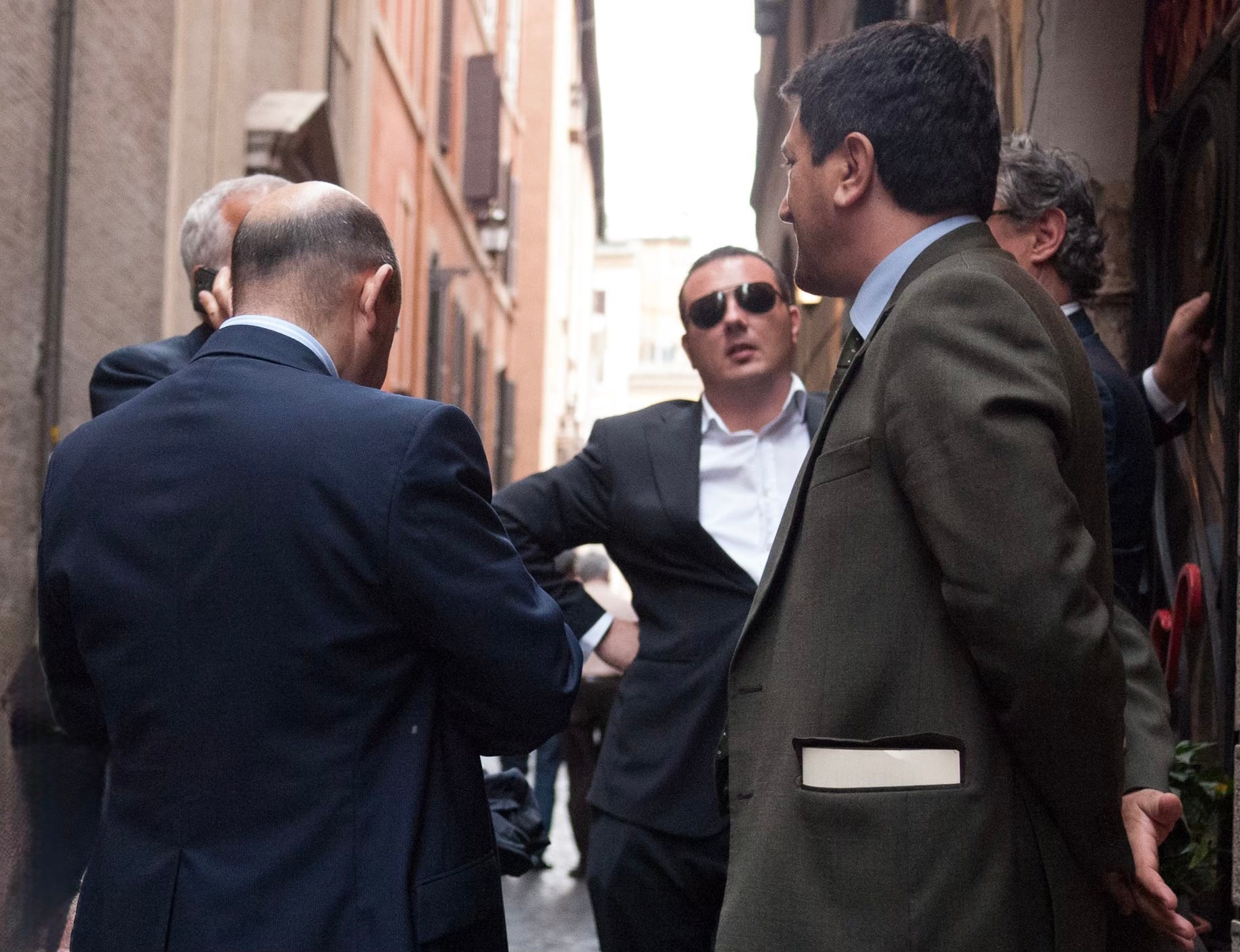
I love the top photo.
I wonder what happened to Federica. Do you know?