Not Up to You
The neighborhood coffee bar decides whether you belong

Near the end of the day, during my move to a new apartment three years ago, the man I’d hired to help stopped in the living room and shook his head.
“Un attimo!” he said, wagging one finger. “Wait a minute! Where are you going to put the television?”
“I don’t have a television.”
He was puzzled. “Then what do you do at night?”
A few days later, one of my new neighbors offered to loan me an old TV she had in storage.
“Just until you can get your own,” she suggested.
A while after that, I was headed toward the dumpster with the oversized box my new dining room tabletop arrived in when the owner of a nearby restaurant smiled and held his hands out in front of him.
“Finalmente!” he said. “You finally got a television!”
Fortunately, over time, people began to pay more attention to my dog Mocha than to my home entertainment preferences. I still wasn’t a local, but I began to settle into a routine.
Every morning, I’d run errands while walking Mocha: first the coffee bar, followed by one or two stops -- maybe the supermarket, butcher, dry cleaner, fruit seller, bookshop, bakery, or pet store. Then I’d usually have another coffee.
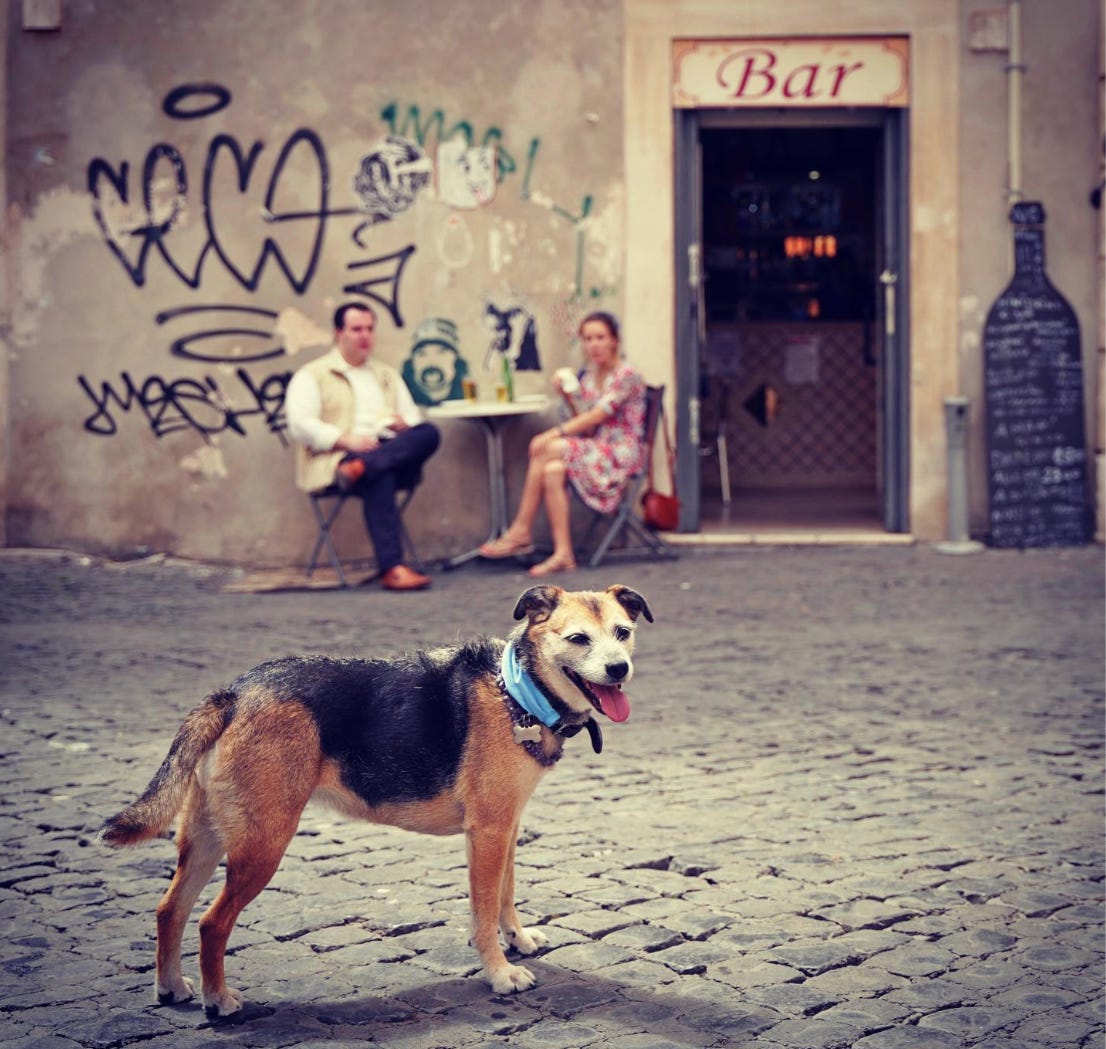
It didn’t take long for the barista at the coffee bar I went to most often to learn my order and make it without being reminded. But he remained formal. Each time, he’d set my caffè macchiato al vetro down with exaggerated care and quietly say, “Lei è servito” -- “you are served.”
It worked that way for months. Then, one day, randomly, at least half a year in, he asked if I was a tourist.
“No,” I said. “Of course I’m not a tourist. I’ve been coming here for months.”
He leaned forward and lowered his voice. “I noticed sometimes you come in here early, sometimes late, sometimes after lunch. Do you have a job?”
“I work at home.”
“What kind of work?”
“I’m a journalist.”
“But you’re not Italian,” he said. “Where are you from?”
“I grew up in America.”
There was a pause, and then his eyes lit up.
“Yes! I’ve heard about you!” He stood up straight, smiled, and crossed his arms and said, “You don’t have a television.”
Order and chaos
You could look at most Italian coffee bars as Italy in miniature.
There are unwritten rules and order hidden amid chaos. Loyalty matters. They’re egalitarian, ritualistic, and often a little messy. And they vary sharply from region to region -- you’ll never confuse Trieste’s cerebral coffee culture with the gritty bars of Rome, or the chic cafés in Milan with Naples’ high-voltage espresso scene -- but at heart, they’re all about community, a humane pace of life, and drinking something delicious.
Why do I order a caffè macchiato al vetro? It’s a simple espresso with a touch of milk served in what amounts to a shot glass. If someone at the bar asks why that order, I tell them it’s so I can easily see how much milk is in it. I drink a coffee in two or three sips and if I don’t realize the barista forgot the milk until after the first sip, isn’t it a little late?
But between you and me (and the Internet), the main reason that’s my order is because it’s a lot more memorable than a plain old caffè macchiato. The order is unusual but not weird (I once heard someone speaking in accented Italian order “a half cappuccino and half caffè latte in a hot glass” -- now that’s weird).
I’m convinced that having a neighborhood barista know who you are is an essential step toward fitting in. That’s something that happens in stages and varies bar to bar. But the general progression is familiar:
Paga dopo
They let you order and drink before paying
Il solito?
They know your order and may start making it before you ask
Amico mio
They start to call you by familiar terms: caro, bello, or amico mio
Al tavolo
They don’t mind if you sit at a table and pay the standing-up price
Come ti chiami?
They learn (and remember) your name
Ben tornato!
They notice when you’ve been away
Offre la casa
Occasionally, they give you something on the house
If there’s a stage beyond the last one, I’ve never reached it. If you have, tell me about it in the comments.
The network
After the barista in my new neighborhood recognized me as the “American journalist without a television,” everything began to change. Somehow, without altering my routine, people in the neighborhood seemed to know who I was.
In Italy, a well-established barista does more than keep the neighborhood caffeinated. He’s a kind of gatekeeper, helping to establish who does and who doesn’t belong.
I am now part of the neighborhood’s community.
Walking by, I was once called into a shop to help translate for a confused tourist. I have been invited to explain American politics (ahem, no comment) to a group of retirees. And on two separate occasions I’ve been asked to give my opinion about the new American pope.
Not only that, but I’ve also been able to tap into the unofficial network to find a good plumber and someone to fix the heating in the living room just before the cold weather arrived. I was told which of the neighborhood tailors to go to for which kind of work, I get a small discount from the flower-seller, and I discovered that one of the stores in the neighborhood closed because the distant landlord suddenly doubled the rent (more than a year later, it’s still unused).
I still go to the same bar most mornings and I order the same caffè macchiato al vetro. But now I’m not just being served, I’m being vouched for.
📌 And another thing
When I first heard the term caffè sospeso during a busy morning at the Gran Caffè Gabrinus in Naples, I thought it was a kind of coffee I hadn’t heard of. A “suspended coffee”? What could that mean? Was it a brand? A method? Why did the man who ordered it walk off before it could be served?
I returned later in the day when things were slower, and I asked a barista what caffè sospeso was. My Italian still wasn’t strong and he misunderstood me, thinking I wanted to order one. He reached for a cup before I stopped him. “No, no,” I said. “Che cosa è?” -- “What is it?”
He grinned. “Un attimo,” he said, and then called over a colleague who spoke some English. The colleague explained that sometimes, someone having a good day would simply pay for their coffee and for an extra one as well, for someone who might be down on their luck.
Coffee in Italy is inexpensive, even at a bar as luxurious as the Gabrinus. For most people, the gesture is economically symbolic. But a small gesture can still be beautiful. It says that good luck wasn’t something that should be guarded, but something to be shared. In a chaotic city like Naples, it was a way of smoothing the rough edges of the day.
There is no bar in Naples where they know my order when I walk in, or where they call me amico mio, or notice I haven’t been around. But I still like to pay it forward. Not every time. Just now and then, when the day feels generous enough for me to share some of it.
Come back next week for another edition of The Italian Dispatch.


Eric.....you are living the life I should have lived!!!! God Bless!!!
I'm always astounded that no matter how busy the bar, the barista knows exactly who is walking in and out! I like your list of stages - so accurate.
Fun fact, we share the same coffee order....