Saved by a Parking Lot
In Rome, the ancient dead survive by chance
Once a man
A 2,000-year-old human skull was lighter than I expected, like papier-mâché dusted with dry soil. Fragile, too. I held it in both hands.
This had once been a man -- someone who’d lived and died in ancient Rome. Until a few weeks ago, he was in the ground, hidden beneath an unremarkable university parking lot.
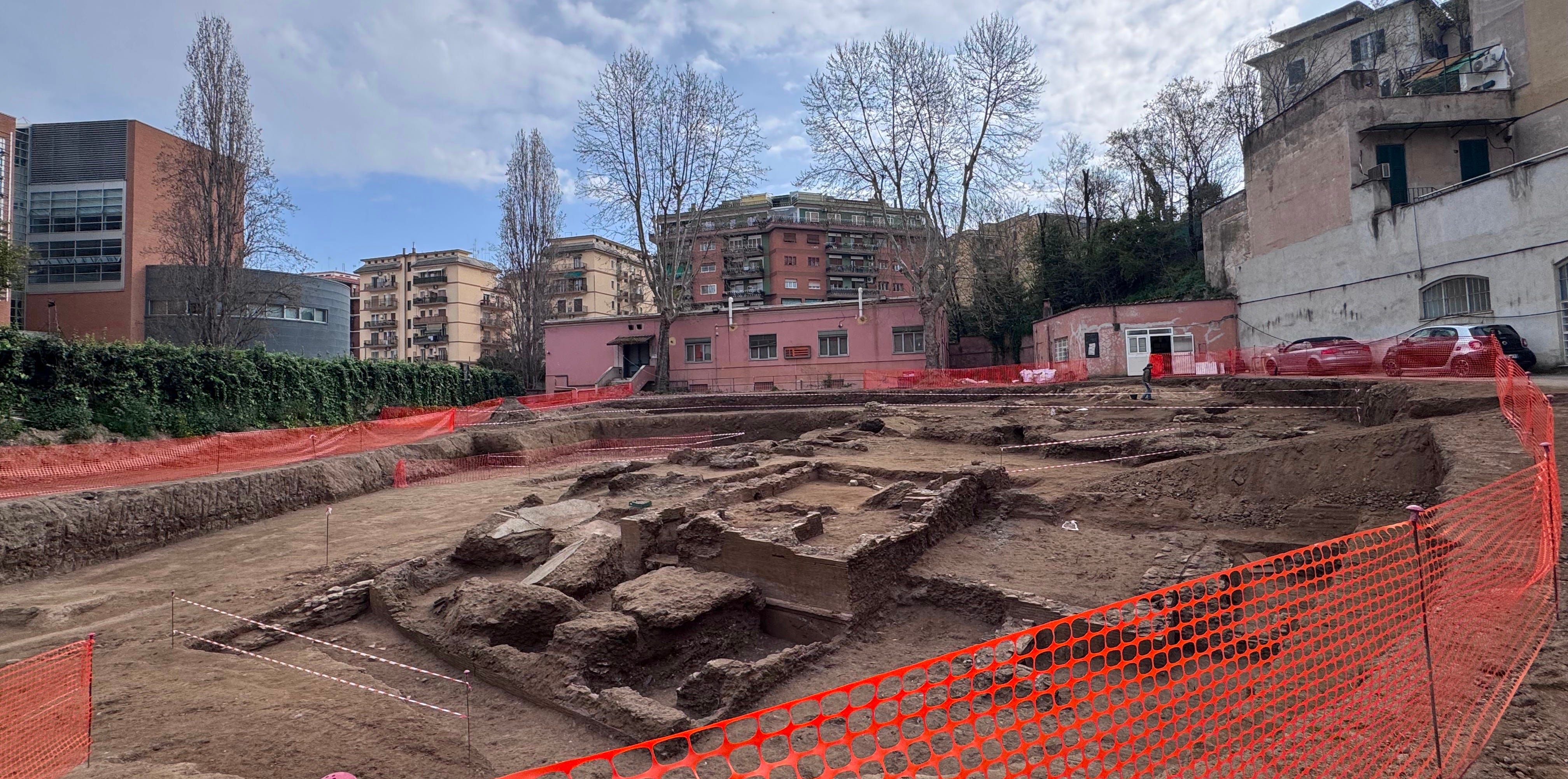
So far, the remains of more than 50 people have been uncovered at Rome’s newest archaeological dig, a short distance from my house. It’s tentatively being called the Necropoli Ostiense.
A year ago, engineers broke ground on what was meant to be a student housing project. Before long, they found a mosaic floor that had been warped by the construction of the parking lot, and then the first of at least 17 small, vaulted roofs of tombs. Construction was halted.
That’s not unusual in Rome, where layers of city lie buried beneath the surface. It’s part of why projects like the city’s Metro C line advance so slowly, now nearly 20 years into what was originally a ten-year build, with at least a decade to go.
Delayed by design
For the people involved, delays aren’t just inevitable -- they’re necessary.
“Rome only makes sense if it preserves its past,” Angela Vecchione, the Ministry of Culture archaeologist heading the on-site Necropoli Ostiense excavation, told me. “The real challenge is to combine the ancient with the modern. That’s what we’re doing here.”
It’s a relatively recent idea.
For most of Rome’s history, there was no archaeology as we think of it today. There was spolia.
People would mine building materials from earlier structures and repurpose them. The Arch of Constantine was decorated with reliefs taken from earlier emperors. Early Christian churches like Santa Maria in Trastevere were constructed with materials from pagan temples. All around the city, Roman columns form part of Medieval walls, marble reliefs become door frames, and ancient fragments are embedded into newer structures. Marble that couldn’t be repurposed intact was ground up, burned, and used to make mortar.
“What we think of as the past was, for most Romans, just part of the city they could use as they wished,” author and urban historian Anthony Majanlahti told me. “It was rare to build something new with all new materials.”
For centuries, the default was to either reuse or destroy. Then came “rescue archaeology” -- building first and then saving what could be saved despite time and financial constraints. It brings to mind the heartbreaking scene from Federico Fellini’s Roma, where metro workers burrow into a buried ancient Roman villa full of vivid frescoes that vanish almost instantly when exposed to air.
Today, the practice in Rome is expensive and time-consuming “preventive archaeology,” which involves investigating, documenting, and preserving archaeological remains before development work is done.
“Today, we don’t look at these remains as obstacles,” Vecchione said. “They’re part of the project from the beginning. Our goal is always to preserve these important connections to our past and still build what the city needs.”
In the case of the Necropoli Ostiense, that means preserving a site the size of four tennis courts while still finding a way to ease student housing pressure for fast-growing Roma Tre university. The details are still in the works, but Vecchione and her colleagues are confident a solution will come. It will just take time.
All we can still save
Meanwhile, the excavation is pockmarked and uneven, as if a wave had passed over it and pulled some parts away.
At this stage of an archaeological dig, tools can range from tractors to shovels and pickaxes to dental instruments and soft brushes.
I visited twice over two weeks. At first glance, it appeared nearly unchanged between visits. But upon close inspection, the changes were dramatic. What had been the craggy tip of a columbarium roof now revealed a Latin inscription etched into marble. A small mound I’d walked across on my first visit had been carved by the return visit. Anthropologist Walter Pantano was there scraping away at a shattered skull. Time had tilted the head unnaturally toward one shoulder and several bones were splintered.
They’d already uncovered more than 50 such remains -- so far mostly males, mostly adults -- but each one was another clue.
“I’d say this was a man, around 35,” Pantano said. “He’s missing two teeth, but the remaining teeth were healthy. We don’t know much else about him yet. But you can never tell what discovery is going to shed new light on the whole project.”
I asked archaeologist Andrea Monaco what was special about this specific plot. Why had burials taken place there and not somewhere nearby? He smiled.
“They didn’t just bury here,” he said. Then, pointing to each of the adjacent buildings, to the wide asphalt of the Viale Ostiense that framed one side of the excavations, and to the tracks of the Metro B line that passed by the opposite side, he continued.
“There were almost surely burials there, there, and there,” Monaco said. “This is what’s left because it was a parking lot. So this is the only part we can still save.”
It’s hard not to think of how much of the ancient city has disappeared. Like everything at the dig, the skull I’d held survived by accident -- protected by a parking lot. In most parts of the world, progress can be measured by the speed with which things get done. But in Rome and other ancient cities, progress today also requires a negotiation with the past.
📌 And another thing
As a pre-teen living in South Florida, I had a clear plan for adulthood: I would split my time between playing American football for the Miami Dolphins and working in Africa as an archaeologist.
I was a skinny kid with poor eye-hand coordination, so the football idea was probably never in the cards.
But at school, the famous The Road of Homo sapiens poster hung on the wall, which I stared at and tried to re-draw from memory. A poured over issues of National Geographic in the school library. When I helped my dad in the yard, I kept an eye out for ancient artifacts or bones any time we dug a hole. We never found anything, but on walks in the woods, I’d occasionally come across native American stone arrowheads, which I still have and treasure.
I bring up all this because visiting the Necropoli Ostiense felt like stepping into a version of my life that might have been. It was a thrill to see how the site is taking shape as human remains and structures slowly emerge.
There, I spoke with Angela Vecchione, the project’s principal archeologist. She told me something unexpected: when she was very young, she wanted to be either an archeologist or a journalist.
A school trip to Pompeii decided it for her. But she also said the difference between the two professions was mostly one of time scale. Otherwise, she said, they aren’t so different: both try to reconstruct stories from fragments and both try to understand how the past can help make sense of the present.
I liked that idea. Maybe I didn’t stray as far from my childhood plan as I thought.
Now I just need to figure out when the Dolphins are holding open tryouts. 🏈
Nota Bene: Nobody’s going to hand you a shovel and tell you to dig. But if this essay unearthed something you’ll remember, a paid subscription helps make The Italian Dispatch sustainable, unlocks the full archive of 44 (and counting) essays, and there's a special offer through March 31. More information here.


Great post! I really like the concept of preventive archaeology so that Romans have an opportunity to catalog their past. Given how young the actual scientific principles are for archaeology, it’s wonderful to see it being given priority in places like Rome. On the other hand, I can very much appreciate that taking the time necessary to excavate and catalog a site before resuming much-needed work runs counter to the need. A bit of robbing Peter to pay Paul with time. Ahhhhh, your descriptions about spolia and Rome’s cannibalization of itself is so perfect. Noticing those random little nuggets embedded in walls or as pillars inside many a Roman church never ceases to amaze me. So cool!
GREAT article!!!!