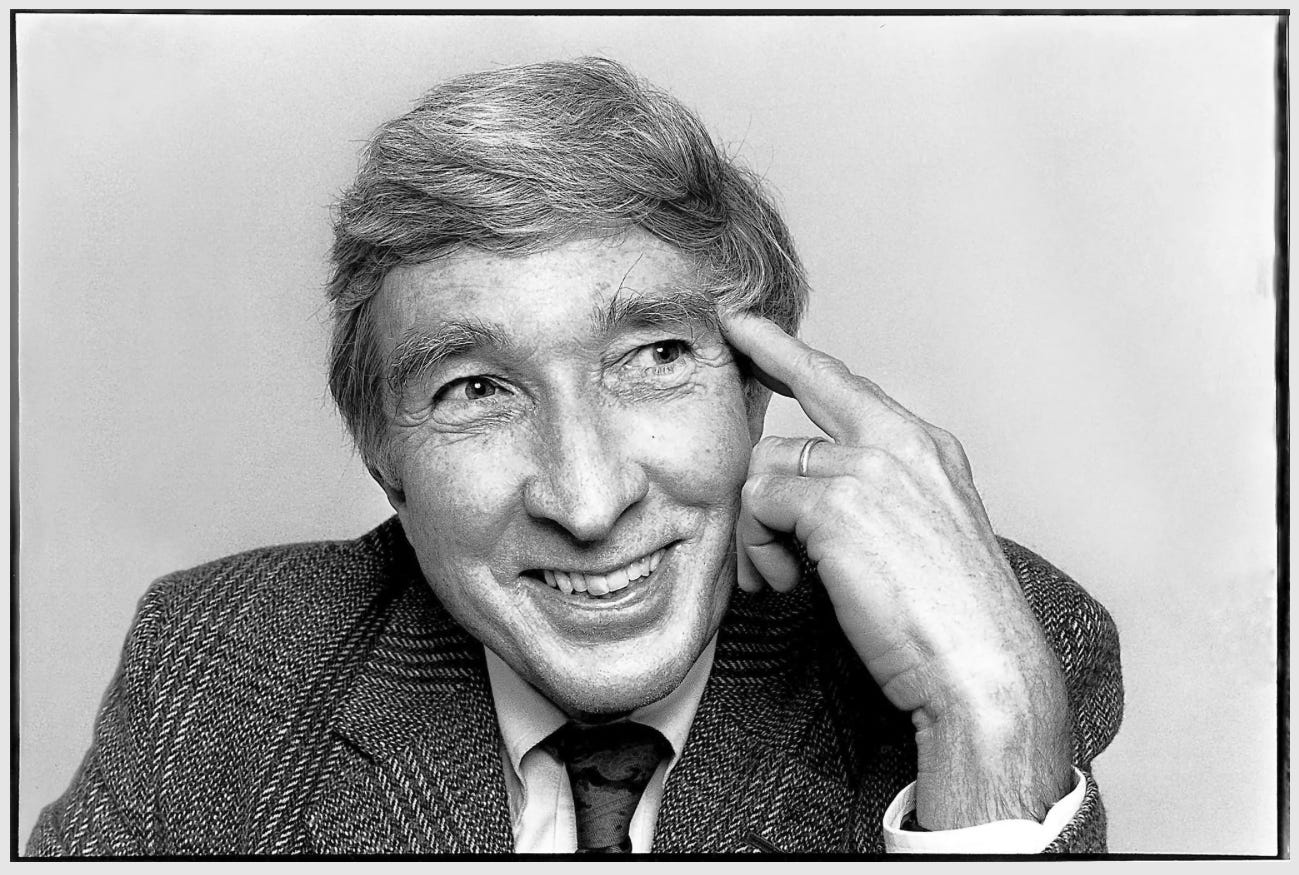
✍️ The Writer Who Knew Too Much
A story about losing my nerve among the literary ghosts around the Spanish Steps
I don’t rattle easily. I’ve covered wars, jumped out of airplanes. I’ve interviewed presidents, been blessed by a pope, attended parties with Hollywood celebrities. Then there was the afternoon when I spotted John Updike having lunch near the Spanish Steps.
He was seated at an outdoor table with a woman in her 50s with short sandy hair, dressed in a navy-blue blazer. She could have been his Italian publisher or agent. He wore a plaid coat and a pale tie. They were talking easily. Their plates were gone but the water glasses were still on the table, along with a small, neat stack of books.
I was on my way to the Anglo-American Bookstore, then still years away from closing down. As soon as I saw him, I changed my path to walk toward their table. Words were already forming on my lips: “Hey, John Updike!”
They both looked up before I could make a sound. I suddenly froze, then turned, then disappeared around a corner.
“Hey, John Updike?” Really? No -- too trite. I needed to approach them like a peer, not a fan. I smoothed out the tuck of my shirt and patted down my hair.
“Are you by chance John Updike?” Better. Then: “My name is Eric. I’m a journalist here in Rome.” They’d say they were happy to meet me and maybe they’d invite me to join them for their after-lunch coffee. I’d laugh at one of Updike’s wry observations.
I strode confidently around the corner and toward the table. They looked up at me again and I thought, wait, who am I to them? I retreated again around the corner. I was in the part of Rome Henry James admired most; Stendhal and Gabriele D’Annunzio had roamed these streets; I was steps from where John Keats breathed his last.
I was furious with myself. Two times? But I can fix this. I’m good with words. I needed to be sincere, polite, gracious. I closed my eyes and took a deep breath. After a moment, the right lines came to me.
“Mr. Updike, please excuse the interruption. Your books have brought me a great deal of joy over the years and I couldn’t pass up the opportunity to shake your hand and say, ‘thank you.’” Who wouldn’t appreciate that?
I puffed out my chest and strode out from around the corner for a third approach. Updike and the woman looked up again, and this time they both visibly sighed. We were separated by only a narrow stretch of Roman cobblestones. But I couldn’t take another step.
Updike would be on any shortlist of the greatest American novelists of the twentieth century, a man who could file a person away in one or two sentences.
“She is a small woman whose skin tends toward olive and looks tight, as if something swelling inside is straining against her littleness. Just yesterday, it seemed to him, she stopped being pretty.”
That’s from Rabbit, Run, the thoughts of Updike’s protagonist, the restless Rabbit Angstrom, describing his wife.
Or take Sammy, a teenage cashier in Updike’s short story, A&P, describing a woman who caught him charging her twice for a box of crackers.
“She’s one of these cash-register-watchers, a witch about fifty with rouge on her cheekbones and no eyebrows. And I know it made her day to trip me up.”
I remembered his precision there on the cobblestones. My sudden fear was that months or years later, I’d be flipping through The New Yorker and come across a passage only I would recognize as myself. What adjectives would he use? Well-intentioned? Please no. Unaware? Eager?
Nobody else would figure it out. But I would know.
There was no fourth approach, no visit to the bookstore. I turned and walked back up the steps. And then I ran. Just like some fool in an Updike novel.
Nota bene: Unlike me on those cobblestones, a paid subscription requires only one approach. Access the full archive: 49 essays and counting. More info here.


I had the chance to meet him when he was on tour for THE AFTERLIFE. I brought with me a VERY battered and marked up copy of PROBLEMS AND OTHER STORIES which one of my professors had us entirely dissect. He signed them both but I remember him being baffled that the prof had us spend so much time with the older book (which is full of exquisite stories!).
Thanks for sharing your moment of feeling ultra-connected to another author--and then pulling back at the realization it was a one-way relationship! Sending you a private message . . .