
The Month That Stopped Stopping
Italy's August disappearing act is being priced out of existence

Their American friend
During my first August in Rome, I couldn’t find a cup of coffee.
The whole neighborhood shut down for most of the month, but my go-to coffee bar went furthest of all -- shuttered from the last day of July to the first of September, at least a week longer than everyone else.
When I finally saw signs of life in the bar, relief washed over me. The steel grating was up only halfway, but I could hear voices inside. I ducked my head underneath it and saw the owner, Tony, his wife, and his nephew, who was the main barista. They were all very tan.
“Il nostro amico americano,” Tony, the owner, declared when he saw me -- “Our American friend.”
“Are you open yet? Could I get a coffee?” I asked in Italian.
The nephew shook his head. “Come back in an hour,” he said with a deep Roman accent. “Even in half an hour.”
Tony cut him off. “Our American friend wants a coffee; we should make him a coffee.” He stepped toward the espresso machine -- one of the old ones, a La Cimbali with a long hand lever instead of buttons. His father had opened the bar when the machine was new, in the 1960s.
Tony delicately placed the coffee on its saucer already sitting on the bar. He and the nephew watched me tear the corner off a packet of sugar, pour it in, stir. The wife came out from the back to watch, too. I raised the cup and smiled. “Salute.”
Then I spit it back into the cup without thinking, so strongly that it splashed onto my hand and dripped to the floor. The coffee was lukewarm, bitter, stale.
“Vedi?” The nephew threw up his hands and glared at Tony. “See? Even the American knows we should dump that coffee into the Tiber!”

A national truce
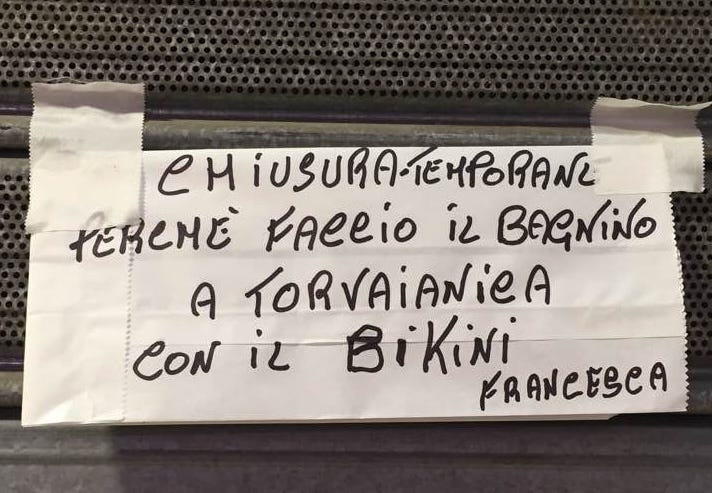
A year ago, I called Ferragosto “the most Italian of all holidays: born in ancient Rome, claimed by the Church, repurposed by politics, and refusing to adapt to modern life.” That’s all true. But I should have added that it is also eroding, slowly … steadily … maybe irreversibly.
Don’t misunderstand: if you’re in Italy on Ferragosto, Saturday this year, you’ll find offices closed, shops shuttered, parking spots appearing out of nowhere -- except at the seaside, which will of course be overwhelmed. Even today, in the lead-up to the holiday, there are moments when Rome feels eerily vacant.
But the days of businesses closing for three, four, even five weeks this time of year, especially in cities, are long gone. Too much competition, too many tourists, life too expensive.
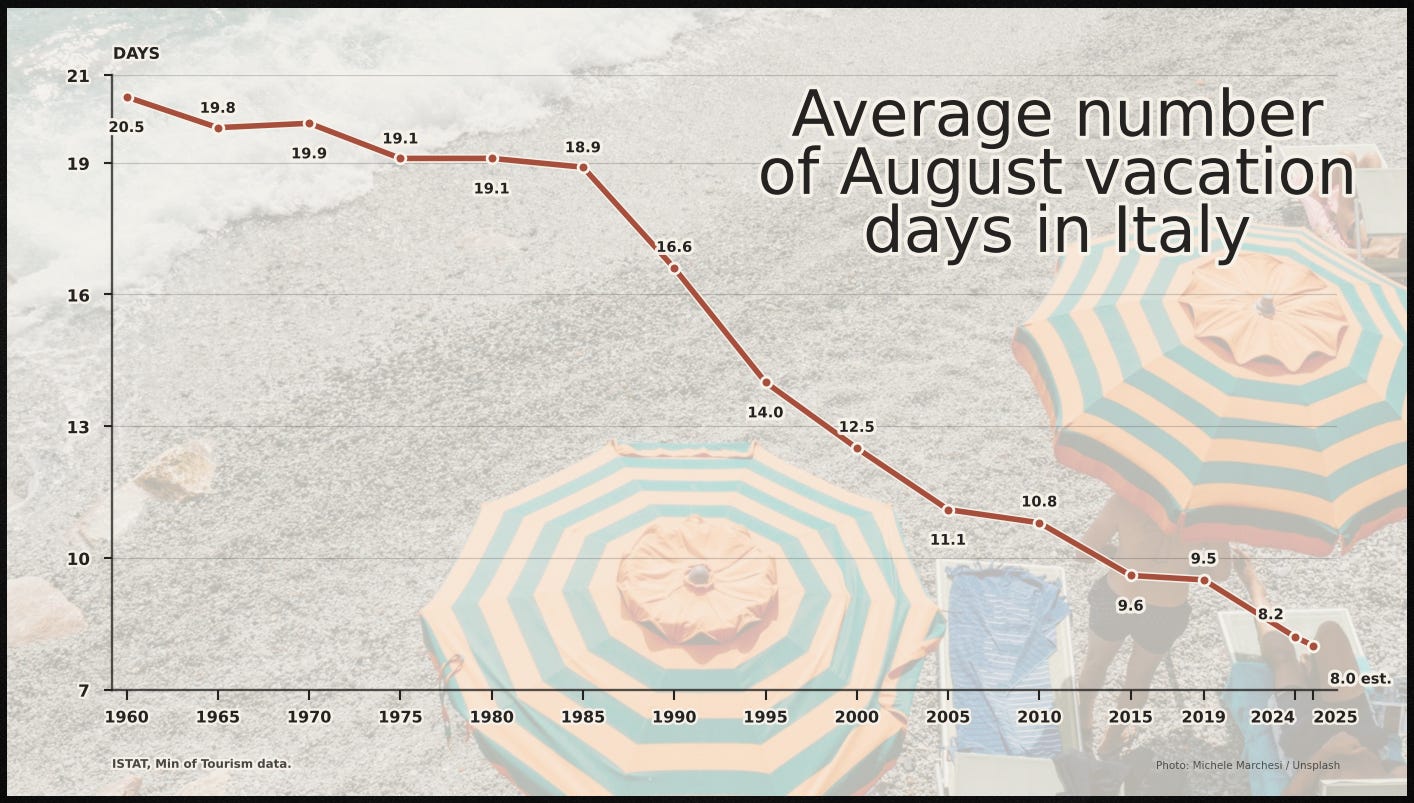
Data on this is messy, but it shows an unmistakable trend. In 1960, the average Italian’s August vacation lasted nearly three weeks, according to government data1; today it’s just over a week. And vacations are increasingly staggered: the country’s largest hoteliers’ association estimates that just 41 percent of Italians will take their longest vacation of the year this month, a number that a generation ago was north of two-thirds.
I think the old August break worked because almost everyone was part of it. Tony, the bar owner, could disappear for five weeks because owners of the other bars, his suppliers, and most of his clientele disappeared as well.
Ferragosto wasn’t a ritual about time off as much as it was a national truce. And once the truce began to fray, every owner had to decide -- a month off or a month’s rent.

Progress of a sort
It’s not just August that’s changing.
The riposo is Ferragosto in miniature: a shop closing for a mid-day meal, a restaurant’s empty stretch between lunch and dinner, or the odd weekday when a family business keeps its doors shut. In city centers and tourist hotspots, the riposo is also disappearing.
Ferragosto itself has survived two millennia in part because it could be reshaped. Caesar Augustus created the Feriae Augusti as a period of rest that he named after himself. Later, the Catholic Church merged the day with the Feast of the Assumption, a Holy Day of Obligation. And during Fascism, the state transformed it into an occasion for mass travel, with cheap train fares encouraging workers to visit parts of the country they might never otherwise see.
Each one demanded people slow down. Now the market forces them to keep going.
Anyone who first arrived in Italy in recent years will still have been astonished by Ferragosto’s reach. And they’re right to marvel. By the standards of most countries, Italy still seems to stop cold in its tracks. What newcomers can’t know is how much more it used to stop, or how much longer it took to start again.
I don’t think Ferragosto itself will disappear completely -- its roots reach too deep to be pulled out. But the perimeter around it keeps contracting.
Much of this is inevitable, and some of it is good. A country where an ill person can find an open pharmacy in mid-August, where there’s easy access to fresh food -- that’s not a loss. What is lost adds up to more than charm or quaintness: it’s a shared permission to stop.
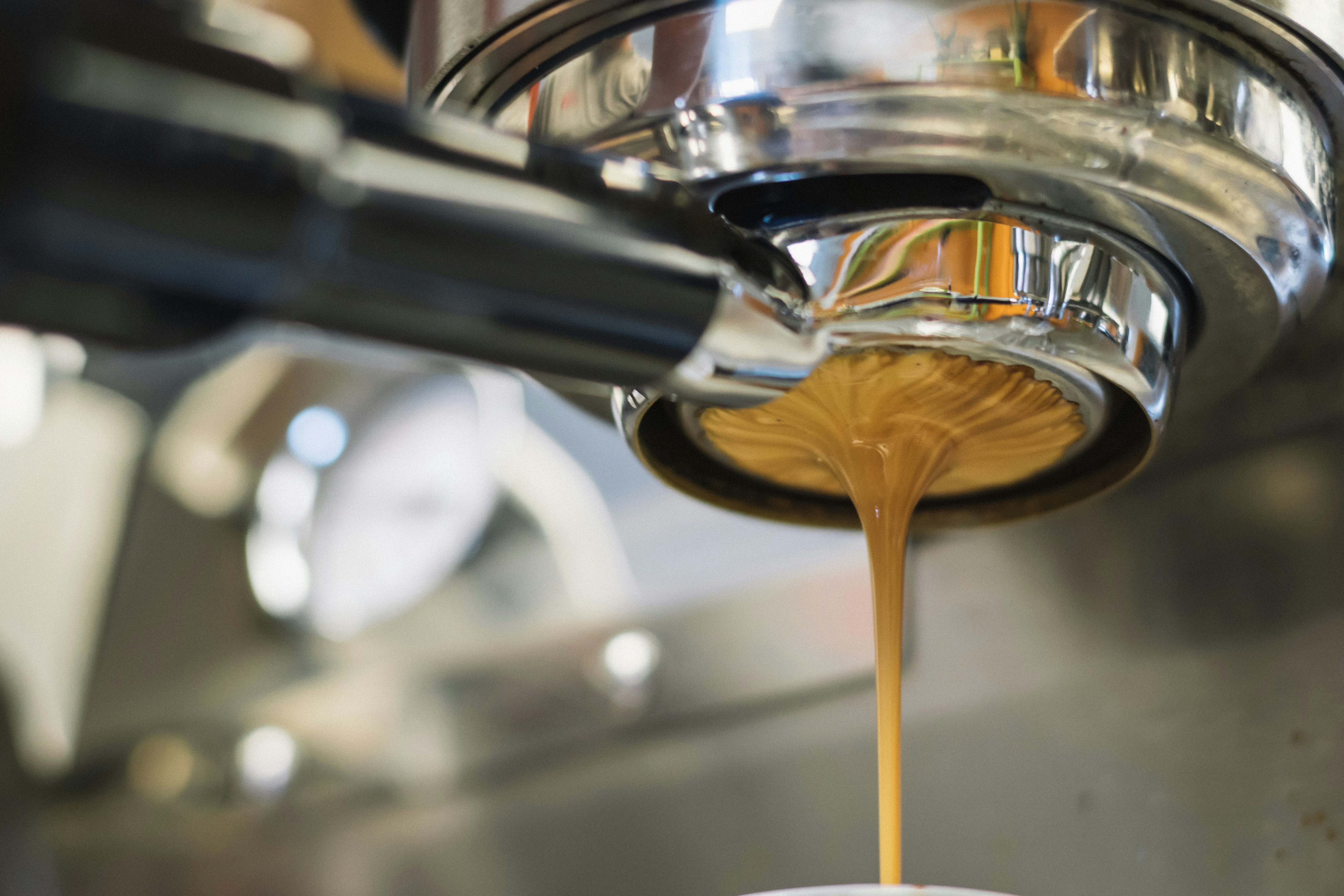
The coffee I spit back into the cup was bad because there’s more to a good espresso than pulling a lever or flipping a switch. A machine that’s sat cold for weeks has to come back to temperature slowly, and its lines need to be flushed. The barista must pull and discard shots one at a time until the machine finally remembers what it’s for.
I have traveled enough to have had more than my share of bad coffee. It may seem like a strange thing for a coffee lover like me to lament, but I know I’ll probably never again have a cup that bad in exactly that way: lukewarm, bitter, stale -- produced by a machine, and by people, who’d been switched off for more than a month.

📌 And another thing
Aside from good coffee, the biggest boast of my go-to coffee bar in my current neighborhood is that it opens every day of the year: Christmas, New Year’s Day, Easter … even Ferragosto.
“People still want their coffee,” the owner, Sergio, told me when I asked about his policy. “Besides, some customers from other bars will come here when their bar is closed and they might like it and not want to go back.”
It makes good business sense.
But regular readers of this newsletter know I have a soft spot for tradition. I’m glad Sergio will be open, but The Italian Dispatch won’t be. I’ll still look in on the comments and will probably pop up in Substack Notes.
Readers will find the next full Dispatch essay on August 25.

Nota Bene: Ferragosto worked because most people took part. Newsletters like The Italian Dispatch work the same way, continuing becaue readers decide it's worth paying for. If these essays -- the ones that notice a culture shifting a coffee at a time -- are worth something to you, consider becoming a paid subscriber. You'll also get the full archive of 60-plus essays, a monthly emailed digest of recent posts and the best of the reader comments, and a mailed gift package. Click here to learn more.
The comparisons aren’t perfect: in the 1990s, ISTAT switched from measuring vacation days to vacation nights, and data from before 1970s is extrapolated from Ministry of Tourism data.
When I was growing up the entire city of Rome would shut down in August. Meanwhile, Silvi Marina, where I spent my summers, was hopping. Families would arrive anywhere between the end of June and end of July (often it was the moms and children who came early in the season to spend the entire summer at the beach; the dads would arrive at the beginning of August). The same families would return to the same hotels year after year. It was a different era for sure.
I'm sad when the old ways change, but it doesn't seem sustainable in the modern world for a whole country to shut down completely 1/12 of the year (or more if you count Christmas and New Years).
I hope there's some middle ground where old values can be preserved and the country can modernize more. What do you thinnk?