What to do about Airbnb?
What does 'living like a local' mean if the locals are gone?
When I travel away from Rome, I act differently than when I leave home for other reasons.
With my trolley suitcase trailing behind me en route to the airport or train station, I like to dangle my keychain, looped through a finger on my free hand. If I can, I’ll make a phone call in Italian -- gesturing, speaking a little louder than normal. I’ll walk with purpose and attack crosswalks aggressively. I don’t take photos. If my dog, Mocha, is trotting at my side, all the better.
These aren’t nervous ticks; they’re camouflage. It’s learned behavior in a city where the line between resident and visitor has grown uncomfortable. And I don’t want anyone to think I’m part of the problem.
Tourist go home
People have been complaining about the noise and crowds the center of Rome since ancient times. The city was Europe’s first true “must-see” destination, after the sprawling network of safe, well-marked Roman roads made it easier for people to visit the Eternal City simply for leisure. By the early days of the Empire, Caesar Augustus was already redesigning the city specifically to impress outsiders.
Today, the problem of over-tourism spreads far beyond Rome. Tourist centers like Florence, Venice, and Naples are strained to near their breaking point. Ditto for smaller hotspots like the Amalfi Coast and Cinque Terre.
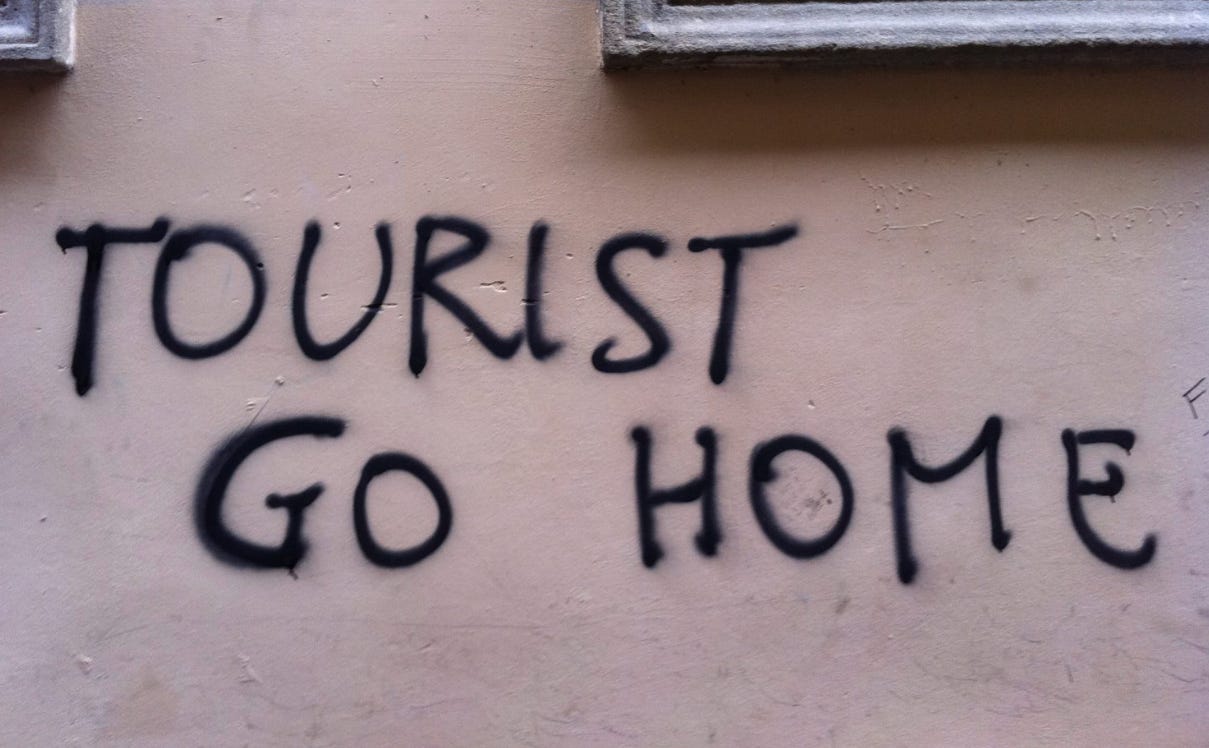
The problem has spread across the continent. Resentment between locals and visitors is on the rise. Last summer, massive demonstrations protesting against over-tourism erupted across Italy, Spain, Greece, and Portugal. Frustrated lawmakers have respond with piecemeal measures: tourist taxes, parking fees, restrictions on where visitors can sit or stand. I’ve seen city walls bearing spray-painted slogans including “Tourist Go Home,” “Your Airbnb was my home,” and I’ve even seen one reading, “Tourism = Terrorism.”
Fairly or unfairly, over-tourism is blamed for contributing to everything from housing shortages and rising prices to falling birthrates, stubborn unemployment, and behavioral changes that follow when residents lose ownership over their neighborhoods.
No bursts of laughter
Airbnb, which has become a lightning rod for this growing backlash, began as an antidote to what the industry calls “checklist tourism.” Its original advertising taglines included phrases like “Live like a local” and “Don’t just go there. Live there.”
But despite a series of policy changes aimed at reducing its social impact, it’s clear the company’s business model has only exacerbated an existing problem1.
I blame the platform for many of the challenges historical centers are facing. It creates irresistible temptations for residents to abandon the most in-demand areas. I’ll quote myself from the newsletter’s essay, Who is Italy for?:
“Entire communities are being hollowed out. As residents flee rising prices and a declining quality of life, neighborhoods turn into stage sets. Local economies become one-dimensional. Culture and traditions turn into commodities. The values and lifestyle that drew so many visitors in the first place begin to disappear.”
The hollowing out is not abstract. Across Italy and much of the rest of Europe it is being lived. It can even be heard. In some neighborhoods, the dominant soundscape has ceased being clinking glasses, bursts of laughter, and the patter of waiters, but the stuttering ka-tak-ka-ka-tak-ka of trolley wheels over cobblestones.
Lungimirante
One proposal I support would require minimum stays of at least 15 or 30 days or allowing short rentals only in rooms within homes where the owner resides, not entire apartments. These measures have been opposed based on claims that they’re anti-tourist, anti-democratic, or unrealistic. But I see them as an attempt to restore balance.
Such reforms wouldn’t end tourism or make Airbnb fail. They would only change who gets to participate.
Legislating minimum stays would push casual weekenders back toward hotels, where tourism is already regulated and taxed. It would also favor longer -- students, researchers, temporary workers, slow travelers -- who buy groceries, learn the bus routes, and venture away from the main avenues and piazzas.
Restricting short-term rentals to owner-occupied homes would preserve the social logic of home-sharing while discouraging the financialization of housing.
Italy has never been particularly lungimirante (“farsighted” -- one of my favorite words to say in Italian) when it comes to policymaking in this area. For example, I think the government should have launched a coordinated national reset for the tourism industry after its collapse during the coronavirus pandemic. Instead, it commissioned dozens of studies, conferences, and proposals that rarely led to even modest change.
I won’t hold my breath waiting for things to change. But I’ll keep up my camouflage when I leave on a trip -- swirling my keys and gesturing to no one, padding conversations with noncommittal Italian phrases: ma certo, ci penso, è ovvio, vediamo.
I’m probably not fooling anyone. But neither are the people in charge.
📌 And another thing
Full disclosure: I’m finishing up this essay from a very nice Airbnb property in the Navigli neighborhood in Milan.
I’m in town for the Olympics (more on that next week). This apartment made the trip possible in a way a hotel couldn’t have. If it weren’t available, the trip would have been more expensive and access to the Olympic facilities more time consuming.
But I don’t think I’m contradicting my argument. This is part of it.
Markets respond to incentives and right now, Italy’s short-term rental market is optimized for people like me: temporary visitors with limited expense budgets. If the changes I suggested in the main essay were in place, this apartment wouldn’t have been available, and this trip might not have worked out.
But what has worked for my benefit has come at a cost for Navigli. I hadn’t been here for more than a decade before this trip, and I can sense the difference made during that time. Long-term residents I spoke to confirmed it.
Evidence of the gritty, bohemian, working class neighborhood of the past remains: the canals that give the neighborhood its name are still used for commerce. There’s a 130-year-old oak tree that honors the neighborhood’s dead from World War I. Traditional shops still dot the street, including artist studios, book and record shops, a ceramics workshop, a watch repairer, and a high-end bespoke tailor.
But the main drag is also filled with cafes and bars, many advertising fixed-price drinks or buffet menus, complete with strolling waiters trying to cajole passersby inside. There’s a restaurant where an unfortunate woman spends all day rolling out pasta under a big window framed by the words guarda & impara (watch and learn). The road is home to a dozen or more souvenir carts selling the same keychains, magnets, and caps. There are posters for a Leonardo Da Vinci boat tour, and signs urge visitors to tag their social media posts with #Navigli.
Navigli remains compelling. I’d like to come back. But it’s engaged in a delicate and high-stakes balancing act -- and the trend lines are familiar.
Nota Bene: A quick note for regular readers -- This week The Italian Dispatch introduced a paid subscription option. New posts remain free to read and discuss; the main change is access to the full archive. The newsletter is a reader supported project and if you’d like to find out how you can help make it sustainable, click here for more information.
I reached out to Airbnb’s press office when I started work on this essay and I heard back from a representative. But my request for comment never went beyond that.


I was glad to see you tried to contact AirB&B ... that's a journalistic instinct. A lot of Substack writers don't bother to do that kind of thing and they just swing away.
It would have been better if they answered. If they did, what do you think they would have said to you?
Great stuff. As one of those regular tourists to Italy I feel 2 ways about this. When I travel over there, I wanna feel like a local and the best way to feel like a local is to be in an apartment. I do go to the store and I do cook and I make my own coffee. I also understand that the mass tourism in the Venice, Florence Rome triad is overwhelming, particularly for locals who just want their town back. The big question for me is what happens to Italy if tourism slows by 10%? What about 20% or more? Italy’s economy has been fragile forever and if tourism were to pull out by 20% I don’t see a big future based on economic trends of today and on that note I’ll say “see you next week” when I come visit you in Italy when I’m staying in my Airbnb!