A Thoughtful Tourist
An essay about borrowing and caring for places we’ll never own
The Borrowed Chevy
A few days after I turned 16, a freshly issued driver’s license in my wallet, my father held out the keys to the family car, a Chevy station wagon. It was going to be my first solo drive. But before handing them over, my father held up a finger.
“Treat it,” he said, “as if it were yours.”
Of course, I didn’t.
I got into so many little fender benders as a young driver that it became a running joke in my family. Once, when I came home with a broken headlight, my mother said the car looked like it was winking. For years, whenever we’d see a dented or scraped car somewhere, someone in the family would turn to me with raised eyebrows and ask: “Eric …?”
I often think about our poor station wagon when I watch visitors “borrow” my adopted city with the same carelessness I had as a teen driver.

Roma! Roma! Roma!
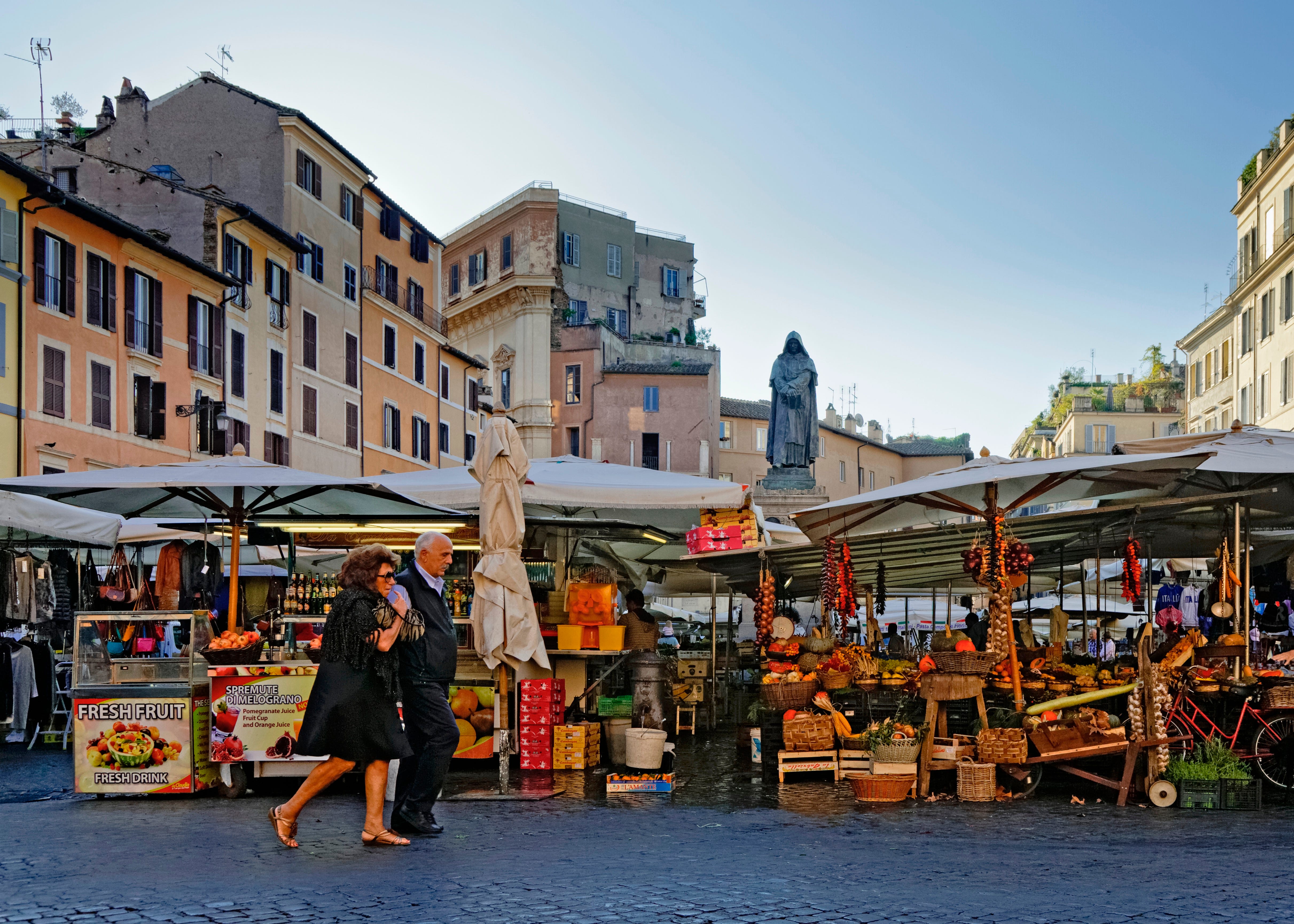
When I first arrived in Rome, I lived in a neighborhood beneath the Campidoglio and looked forward to shopping in Campo de’ Fiori, the closest outdoor market to my apartment.
There, I’d sometimes run into chefs, including the one from my favorite neighborhood restaurant, shopping for the day’s produce. Beneath the stare of Catholic radical Giordano Bruno, vendors showed me how to pick the best Romanesco broccoli (look for sharp tips on the spirals) and puntarelle (the shoots should snap when bent). There was even a gritty coffee bar the Roman stallholders preferred that made me nervous to walk into the first time. But after a few visits, the barista started calling me carissimo.
Today, the Campo de’ Fiori market has turned into a stage set: perfectly arranged baskets of flowers, dried spices, truffle-flavored products, souvenirs. Last time I was there, a man selling Italy-themed aprons, grappa in bottles shaped like the Colosseum, and penis-shaped pasta was standing on a chair shouting, “Roma! Roma! Roma!” The gritty coffee bar? It now has colorful banners outside advertising takeaway coffee and Spritz cocktails.
Campo de’ Fiori isn’t alone. Neighborhoods all over the city -- all over Italy, for that matter, and across Europe -- are loosing their identities. But ordinary Rome hasn’t disappeared, it’s just moved further out.
An Amusement Park
A few weeks ago, someone in the Rome forum on Reddit asked for advice on non-touristy places to visit and eat outside the city center. I gave my thoughts on southern Rome: “There are many non-touristy places in Garbatella, Ostiense, and San Paolo,” I wrote. “There really isn’t a touristy place beyond Testaccio on that side of town. So, just pick one based on what it looks like, or look for online reviews and filter for Italian [comments], and then pick a highly-rated one near where you are when it’s time to eat.”
I posted my comment and felt like a generous Almost Roman.
Then came the responses, all in Italian. “I ask you to edit your message to exclude the few places where we citizens still manage to live in peace,” one guy wrote. “We young people … only suffer the consequences, watching our city increasingly transform into an amusement park.”
I was dismissive in my response, something about him over-estimating the reach of a single Reddit comment.
The young Roman’s reply: “Your answer will remain on the Internet forever, for whoever searches for ‘non-touristy places in Rome.’”
We All Live Here
San Paolo, where I live, is a non-touristy part of Rome, despite being home to one of the city’s four great basilicas and sitting only two metro stops outside the ancient city walls. But in a way, it suffers from the same problems as the historic center -- too many people just passing through.
In the case of San Paolo, though, they’re the students at Roma Tre University.
Almost every night, when I’m walking my dog Mocha, I see groups of students gathered on the neighborhood’s staircases drinking and laughing until late. Then, in the morning, when Mocha and I walk to my go-to coffee bar, we pass the same spots littered with left-behind beer bottles, pizza boxes, and cigarette butts.
The students obviously aren’t tourists. But, like many tourists in the city, they don’t have a stake in the place.
Some nights, Mocha catches a student’s attention, and we’ll end up chatting briefly about her. When that happens, I’ll eventually say, “Ragazzi, we all live here. Have fun, but please throw away your trash.” There’s always enthusiastic nodding and then in the morning, almost always, no trash is left behind.
If I’m correct that the students need a reason to belong, then it turns out that a man with a dog and a foreign accent saying “we all live here” can be enough to give them one.
The $800 Honda
The young Roman on Reddit was right in diagnosing the problem, but he was wrong about the cure.
The solution to over-tourism can’t be keeping places off the map, to un-write parts of the city and hoping nobody finds them. The solution must be about giving visitors a stake in the place -- convincing them to treat where they are, however briefly, as if it were theirs.
I’ve been making this case for a while: urging travelers to slow down to allow time to know a place, against too much dependence on the tourist economy, for rules requiring 15- or 30-day minimum stays for B&B rentals in high-demand areas, and about the virtues of off-season travel. Underneath all those essays is the same idea: Try to know a place well enough to do more than simply consume it. Try to become A Thoughtful Tourist.
A few years after my family traded in the battered family station wagon I bought my first car: a used, copper-colored Honda Civic that cost me $800. There was a rust spot on the hood and if I took my hands off the steering wheel, it drifted to the left.
But it was mine. I washed it, waxed it, refused to let passengers eat inside. But it wasn’t about ownership, it was about responsibility. Unlike the Chevy, a dented door on the Honda was mine to fix.
You can never own a city. But you don’t have to own it to feel responsible for the dents left behind.
📌 And another thing
One of the problems with over-tourism is that it can seem beautiful from a distance.
That’s one of the uncomfortable lessons of The Siege of Paradise, a soon-to-be released documentary about Cinque Terre that I recently watched as a media screener (watch the trailer). The film has gorgeous panoramas, it’s at times funny and ironic, and is ultimately gentler than its title suggests.
Director Gar O’Rourke skillfully weaves together the stories of winemakers, restaurant owners, local officials, aging residents, fishermen -- and two Chicago influencers who burst onto the scene, phones in hand.
The two women would be easy to mock, and the film briefly seems to be doing that, showing them talk about beaches, spritzes, the perfect selfie, and “Italian culture.” But The Siege of Paradise is more nuanced than that. They’re not monsters. They aren’t even especially bad tourists. They seem to become more self-aware over the course of the film.
The film sidesteps the cliché that cast visitors as villains and locals as saints and instead shines a light on a place caught in an impossible trap: the tourists are exhausting, they are ruining what they came to admire, and they are absolutely necessary for the local economy to survive.
It’s a bleak story being repeated in small, fragile places across Italy -- the Amalfi Coast, Civita di Bagnoregio, Lake Como, even Venice -- and far beyond.
A big city like Rome can absorb much more, reinventing itself neighborhood by neighborhood. But small villages have no place to hide.
Nota bene: Paid subscribers have a stake in this place. They get access to the whole neighborhood -- every essay in the archive, more than 50 and counting -- plus a monthly digest of recent posts and the best comments from readers and more. Click here to learn more.
A special tip of the cap this week to David Mastro Scheidt, Chiara, and M. M. Fosco, whose comments in previous discussions (here and here) helped inspire this essay.


VERY thoughtful and beautiful! What a heartwarming true story. We are all responsible for every place we stay in, no matter how short or long. This type of respect needs to be taught at home and at school. I think we need a lot more of those "Man with the Dog" to remind us how to be better and more conscious citizens of the world. Thank you Eric!
I think your dad might just have had it wrong, meaning I am lead to hypothesize that him knowing you were still an irresponsible kid, or at least an inexperienced and youthfully distracted driver at sixteen years old, he might have done better telling you to "treat it like IT'S NOT YOURS!". Perhaps there is a cultural divide between people and their cultures, one of them being self-centered, self-important, where it's about my way of gratification, and another where the good and respect of others takes precidence. Personally I think the middle road is a good one to aim for, i.e. being yourself while giving true respect to the other person, culture, or place. I love fitting in where I go, and while that's not possible in many places on the globe because 6'2" fair skinned men in many places stand out like a sore thumb, there are energetically respectful ways to achieve this I've often found. To me "going local" is precisely that, feeling the place from a neutral point of view, and doing in Rome as Romans do.
But it also takes two to tango, and some locals don't know how to be welcoming or accepting of visitors, especially the ignorant ones (those who still know little), not seeing them solely as a needed source of income, not knowing how to approach them because the language and culture gaps seem insurmountable.
Once the world becomes less authentic, more uniform, and culturally globalized, these differences might subside altogether, creating a boring tourist trap after another, solely based on preformed conceptions, spouted ad nauseam by Ai influencers.